

Check out the separate Sonoff AirGuard TH Temperature and Humidity sensor review.
As part of the AirGuard series, Sonoff opted to release two separate air quality monitors rather than a single all-in-one device. While both the CO2 and PM models measure temperature and humidity, one is dedicated to monitoring carbon dioxide while the other focuses on particulate matter. Furthermore, the AirGuard TH serves solely as a temperature and humidity sensor and does not include any air quality monitoring capabilities.
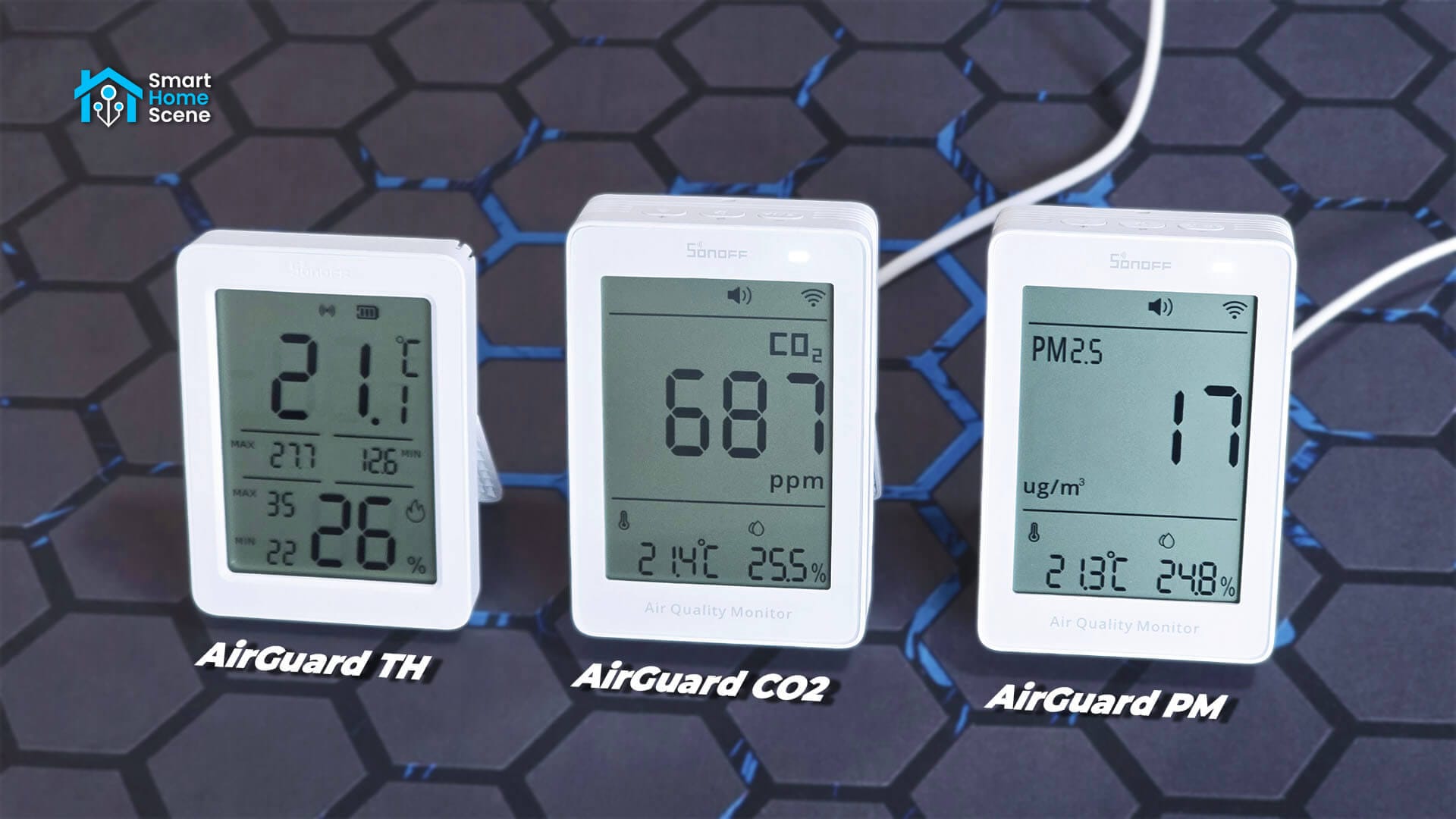
I’ve had all three for a while now, running them side by side in my office. In this review, I’m sharing my experience with the new Sonoff AirGuard PM & CO2 Air Quality Monitors. These are Matter-over-Wi-Fi smart sensors which measure temperature, humidity and PM or CO2.
You can get them on Amazon [CO2, PM], AliExpress [CO2, PM] or Sonoff [CO2, PM].
Technical Specs: AirGuard TH vs CO2 vs PM
I have compared the technical specs for all three AirGuard sensors below. While they look similar, their internal components, power sources, and connection methods vary, which will affect how they work in your smart home.
 |  |  | |
|---|---|---|---|
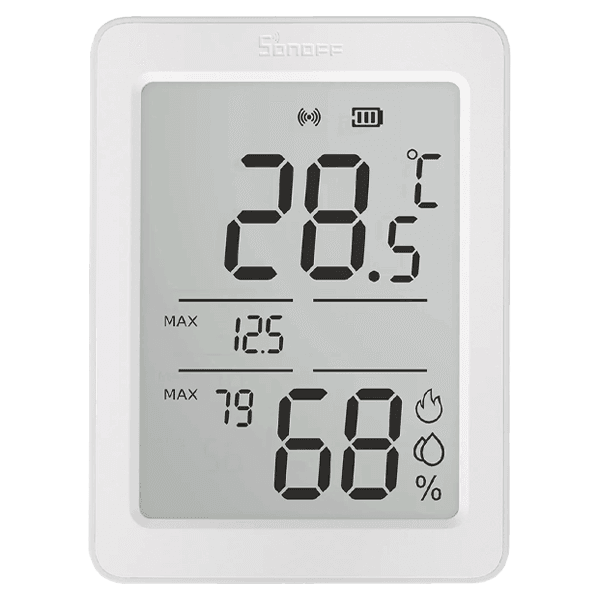
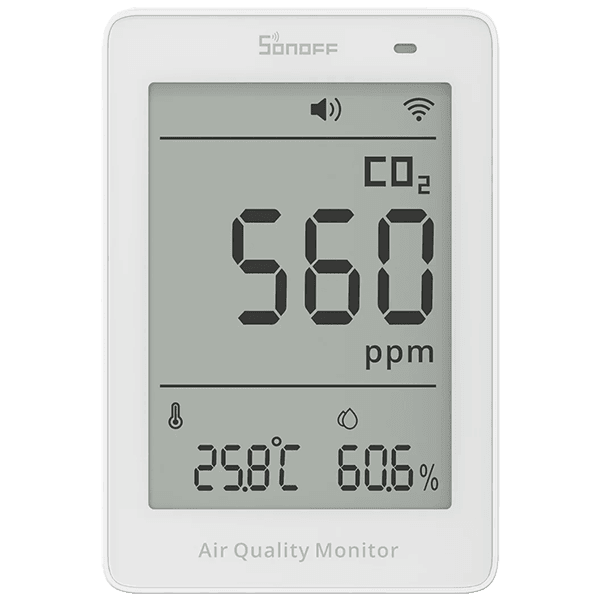
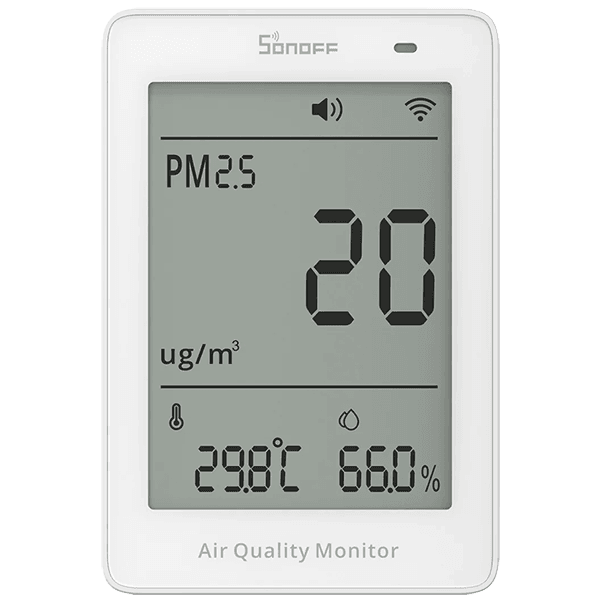
| Name | AirGuard TH | AirGuard CO2 | AirGuard PM |
| Model | SNZB-02DR2 | SAWF-08P | SAWF-07P |
| MCU | TLSR8656F512ET32 | ESP32-D0WDR2-V3 | ESP32-D0WDR2-V3 |
| Protocol | Zigbee 3.0 | Matter-over-Wi-Fi | Matter-over-Wi-Fi |
| Power | 2xAAA | 5V1A, USB-C | 5V1A, USB-C |
| Display | 3.6″ LCD | 3.73″ LCD | 3.73″ LCD |
| Dimension | 95x70x18.2mm | 70x103X26mm | 70x103X26mm |
| Weight | 99.3g (with battery) | 101g | 127.6g |
| Casing Material | PC+ABS | PC+ABS | PC+ABS |
| T/H Accuracy | ±0.2 °C, ±2% | ±0.5 °C, ±3% | ±0.5 °C, ±3% |
| CO2/PM Accuracy | / | ±50 ppm |  ±10µg/m³ ±10µg/m³ |
| Mounting | Stand/Hook | Stand | Stand |
| Price | $14.90 [Sonoff, Amazon] | $49.90 [Sonoff, Amazon] | $39.90 [Sonoff, Amazon] |
While the specs are similar, the internal hardware is where these devices differentiate themselves. The AirGuard CO2 (SAWF-08P) is built around the Sensirion SCD41 [Datasheet], a high-end miniaturized photoacoustic NDIR sensor. Unlike cheaper chemical or VOC-equivalent sensors, the SCD41 uses photoacoustic technology to directly measure CO2 molecules, ensuring long-term stability and high accuracy.
On the other hand, the AirGuard PM (SAWF-07P) utilizes a Plantower PMS9103M [Datasheet] laser-based particle sensor. This sensor is capable of detecting microscopic pollutants as small as 0.3 microns, providing rapid 2-second update intervals for PM2.5 and PM10 readings.
Overview and Package Contents
The Sonoff AirGuard PM and CO2 air quality monitors ship in a large white box containing the device, a USB-A to USB-C power cable, and a user manual. Unlike the Zigbee range, which features recognizable orange boxes, the Sonoff Matter range uses all-white packaging.
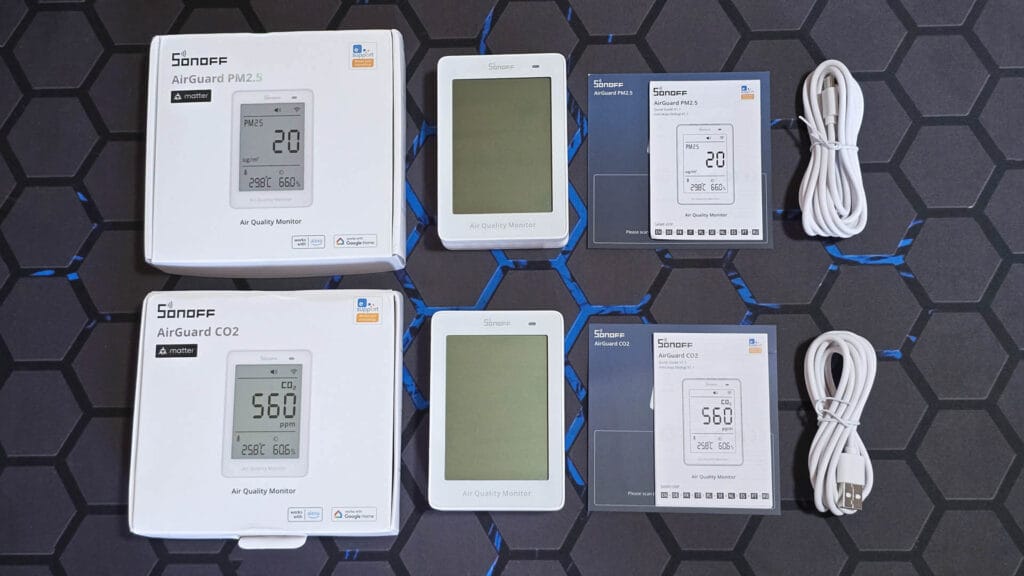
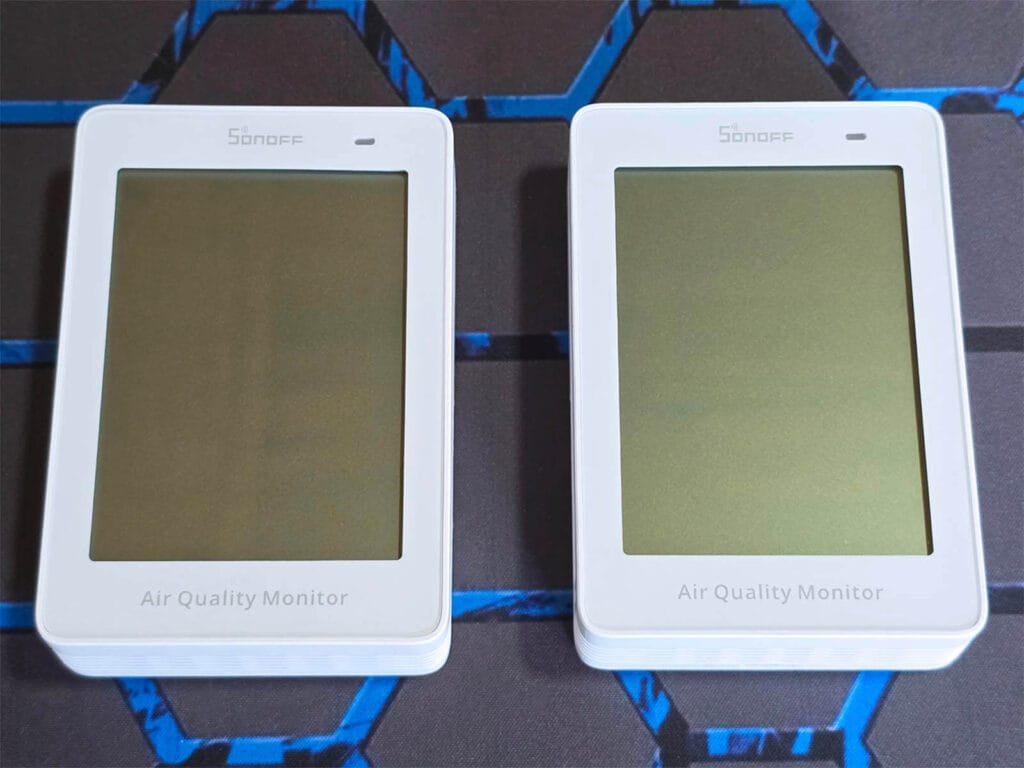
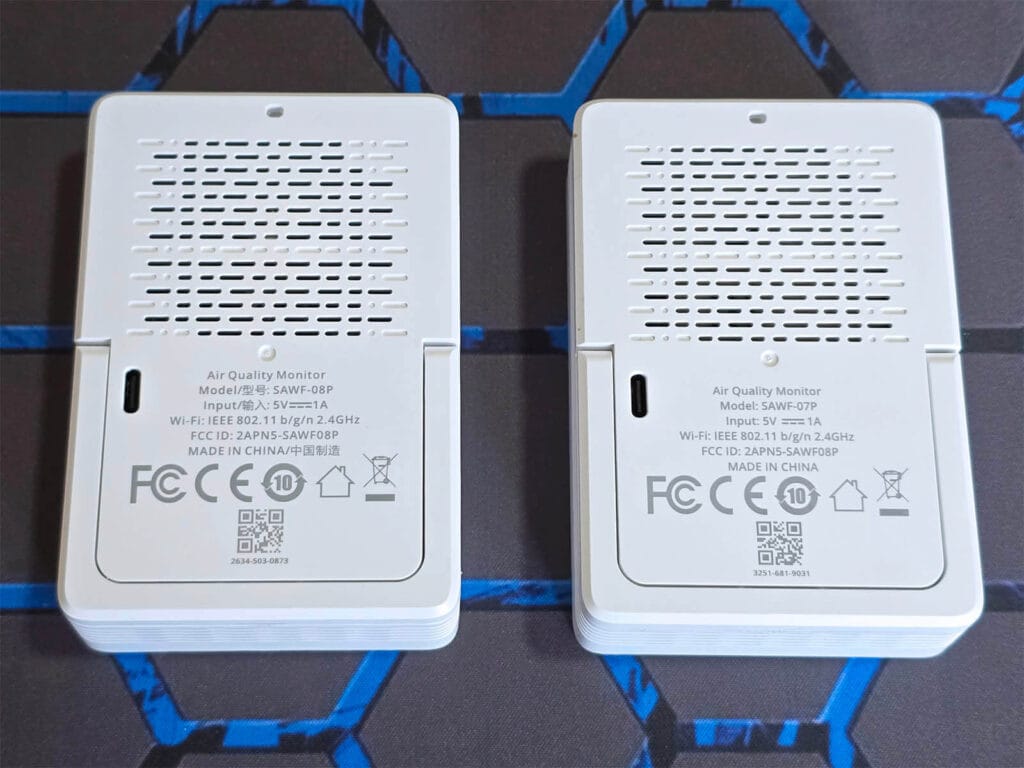
The devices themselves are exactly the same, sharing identical physical dimensions and the same 3.73-inch LCD display. Unless they were powered on or you checked the product labels on the back, you would be unable to tell them apart. Both air quality monitors are powered by 5V/1A and connect only to 2.4GHz Wi-Fi networks.
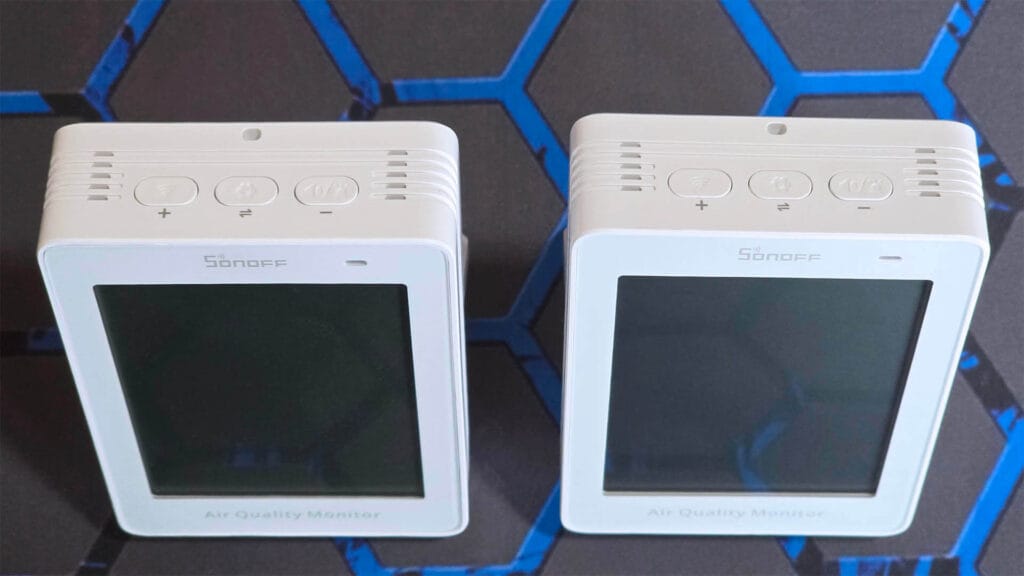
On the top of the case, you will find three buttons for controlling the AirGuard monitors. To connect it to Wi-Fi, hold the first button for five seconds to start a three-minute pairing window. The third button controls the sounds and the light. Tapping it turns the alarm buzzer on or off, while holding it for three seconds switches the LED status light on or off. If the alarm starts beeping, one tap silences it for 30 minutes, and two taps turn the sound off completely.
The middle button is for changing settings and fixing the readings. Tapping it enters a “Menu Mode” where the temperature icon flashes. In this mode, you can tap the middle button again to pick what you want to change, like the temperature unit or the type of dust (PM2.5 or PM10) shown on the screen. You then use the side buttons to move numbers up or down. If you want to undo your changes, hold the middle button for 10 seconds to reset everything to the original factory settings.
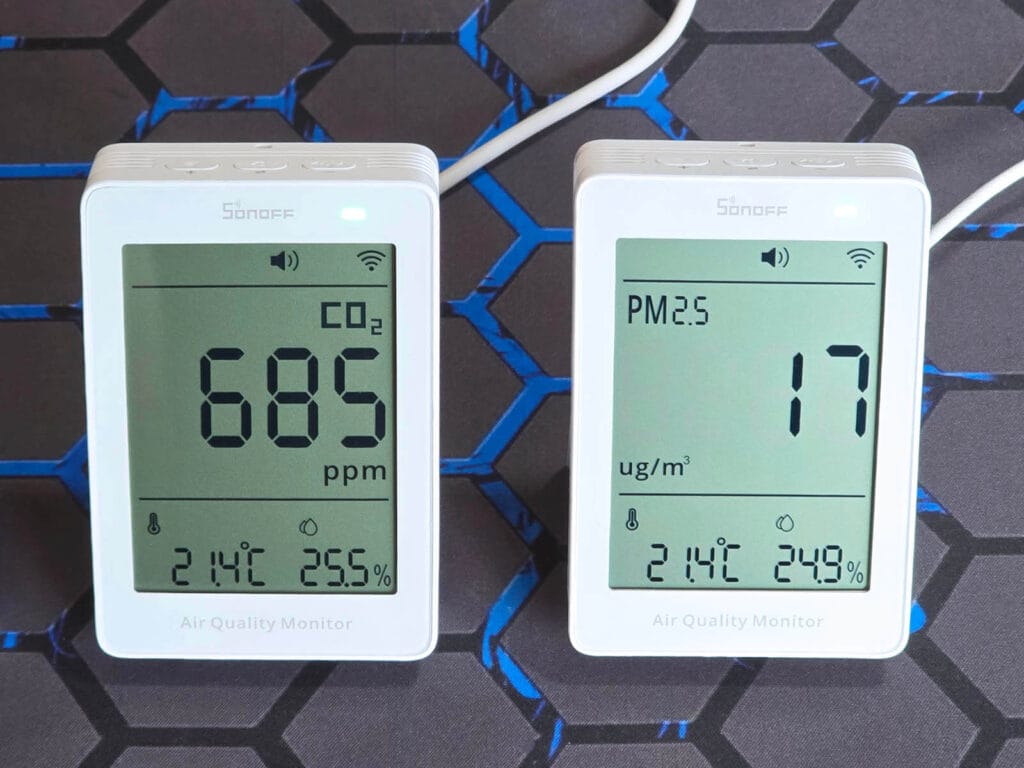
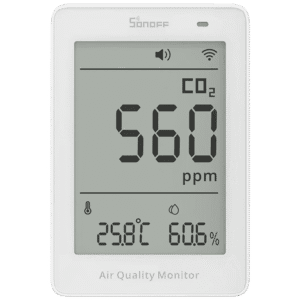
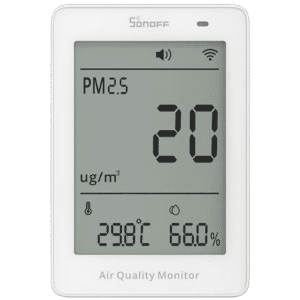
Once you turn them on, there is obviously a clear difference between the two. The CO2 model features a dominant ppm reading of the carbon dioxide in the room, while the PM model shows the particulate matter reading in µg/m³. At the bottom of the screen, the room temperature and humidity are displayed, while the top bar has a simple connectivity indicator and a siren symbol for air quality alarms.
Home Assistant Integration via Matter
The Sonoff AirGuard PM and CO2 Air Quality Monitors use Matter-over-Wi-Fi and can be added directly to Home Assistant. There’s a QR pairing code on the backside of each device you can scan and add the devices. Once paired, here’s what is exposed in Home Assistant for each device:
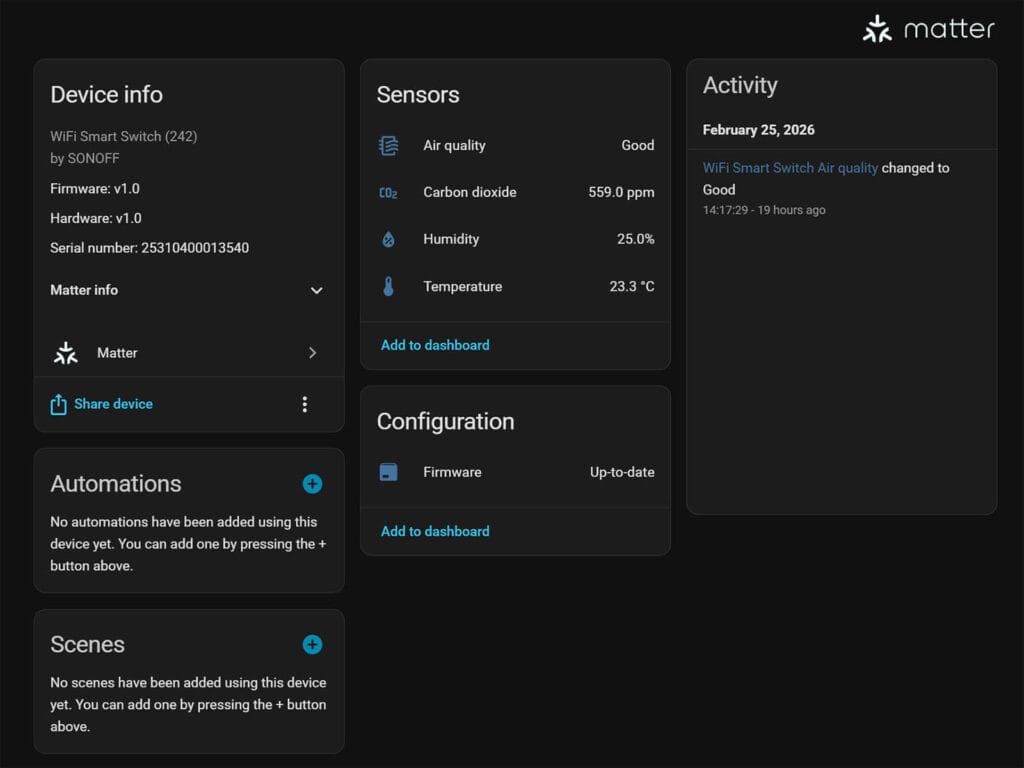
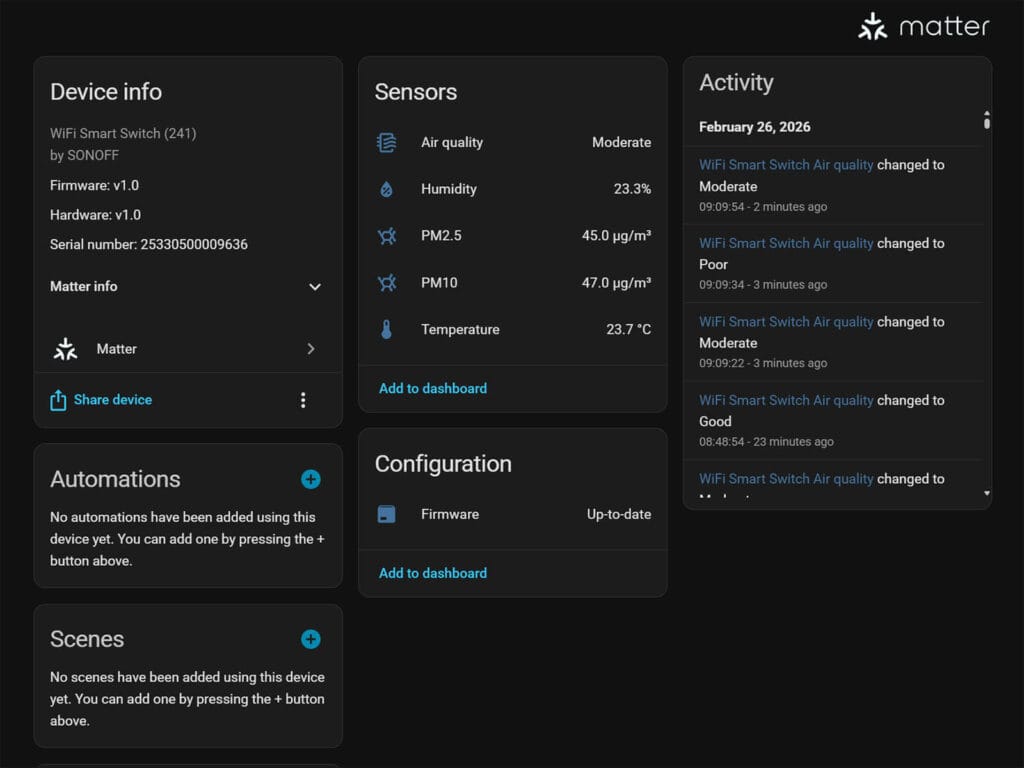
Both devices expose an air quality sensor that changes between “Good,” “Moderate,” and “Poor” based on the current readings. Additionally, you get temperature and humidity readings from both, with units that can be switched between °C and °F using the physical buttons.
Finally, the SAWF-08P model features a Carbon Dioxide sensor, while the SAWF-07P version monitors particulate matter via PM2.5 and PM10. The CO2 model measures in ppm by default, while the PM version records readings in µg/m³.
Interestingly, both sensors are labelled as “Wi-Fi Smart Switch” and I’m not sure why.
Testing and Benchmarks
In order to test the accuracy of the AirGuard PM and CO2 sensors, I installed them in my office, next to an airQ Science Sensor I previously reviewed. The airQ is an expensive multi-sensor monitor which measures a whole array of air pollutants, including PM 2.5, PM10 and CO2.
Regarding carbon dioxide, the AirGuard SAWF-08P consistently recorded slightly higher than my AirQ Science reference sensor. The maximum discrepancy was approximately 35 ppm, while the average offset typically fluctuated between 10–15 ppm. Despite this slight elevation, the data curves mirrored each other closely, with both devices accurately tracking peaks and troughs in real-time.
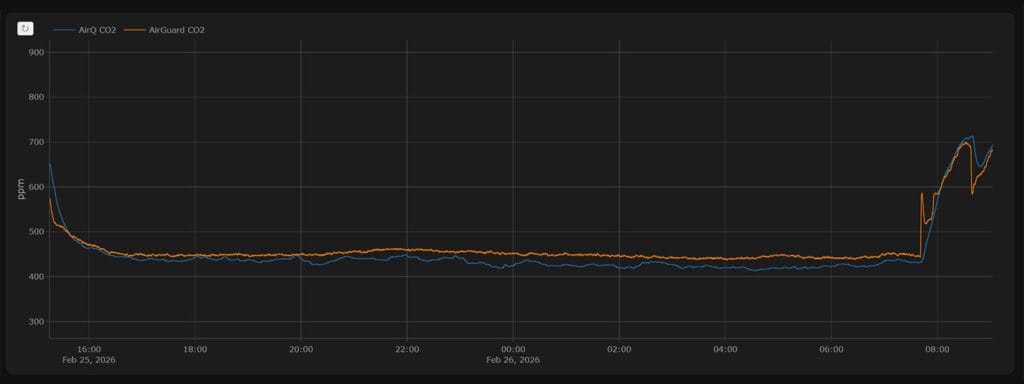
On one occasion, the reading spiked to 50 ppm above the AirQ, though this was likely caused by me moving the sensors during testing. These findings align with the monitor’s technical specifications, as its professional-grade NDIR sensor features a rated accuracy of ±50ppm or ±5% and updates its readings every 5 seconds. Overall, the AirGuard provides highly reliable and responsive CO2 data.
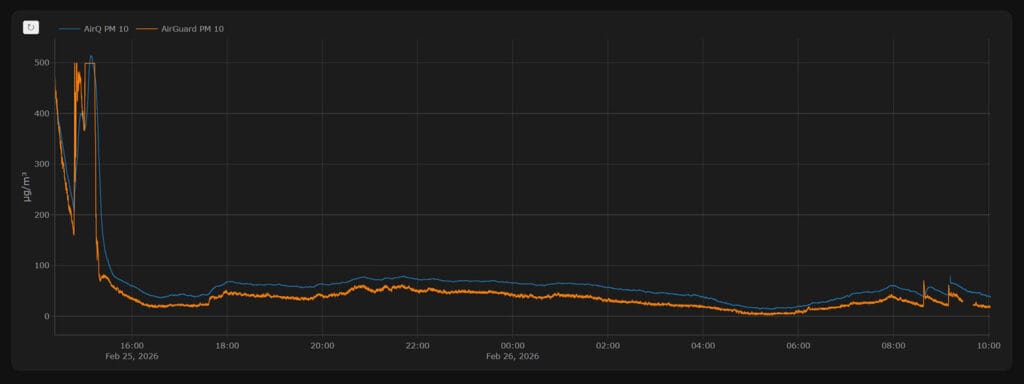
The opposite happened when benchmarking the PM2.5 and PM10 particulate matter data. Instead of reading higher, the AirGuard averaged 15–20 µg/m³ lower than the AirQ Science sensor. Unlike the CO2 testing, there were no major unexpected spikes, and the graphs remained closely mirrored between both devices.
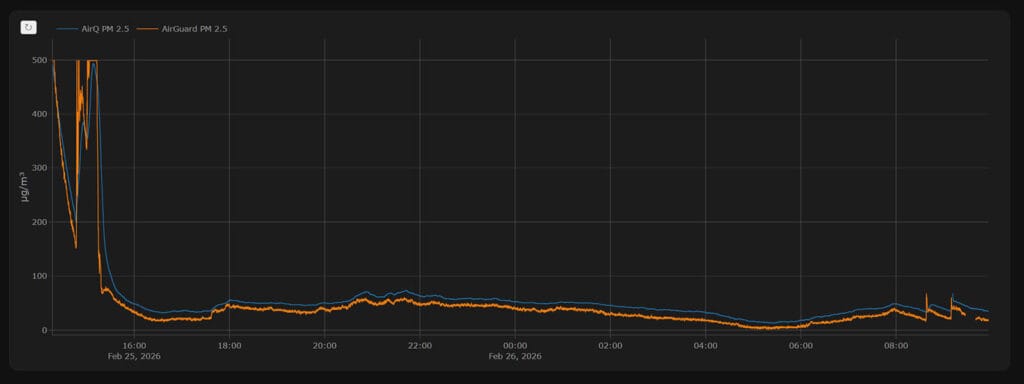
Particulate matter levels rise rapidly when there’s dust floating in the room, which is clearly visible at the start of the graphs for both PM2.5 and PM10. This responsiveness is supported by the internal laser sensor, which also updates very fast. Overall, the AirGuard provides accurate and highly reactive PM data.
Final Thoughts
The Sonoff AirGuard CO2 and PM devices are a solid entry into Matter-enabled air quality monitoring. After running both the CO2 and PM models side-by-side with the airQ Science as a reference sensors, I’m impressed with their performance. The CO2 model’s NDIR sensor is responsive and accurate, typically staying within 15 ppm. Similarly, the PM model’s laser sensor reacts almost instantly to dust, providing reliable data even if it trends slightly lower than more expensive benchmarks.
I’m still not entirely sure if releasing separate devices for CO2 and PM is strictly warranted, as having both in one unit would certainly be more convenient for most users. However, I can see how this modular approach does give you the flexibility to only pay for the specific metric you care about. If you only need to track ventilation, the CO2 model is a great pick; if you’re worried about dust or smoke, the PM model has you covered.
Overall, these are good, reliable sensors that integrate perfectly with Home Assistant via Matter. They are simple to set up, easy to calibrate, and provide clear physical displays for at-a-glance monitoring. The displays themselves have good large, bolded numbers and great viewing angles for LCDs. If you want no-nonsense air quality tracking that just works with your smart home, these are worth the investment.
Check out the separate Sonoff AirGuard TH Temperature and Humidity sensor review.




How did you integrate directly to ha over the matter? I tried the matter integrate through scanning the QR code but it keep failing.
I had to add the device in Ewelink app first, then use the matter numeric code from the app and input into ha matter.
Is this correct?
That’s called Matter multi-admin or multi-fabric sharing. The same thing basically, but you should be able to add it to HA direclty without issues. Sounds like a network issue to me
according to my smart home strategy I am abandoning wifi solutions and switching to zigbee. Therefore the new devices are unsuitable
The same for me, I want to buy a Zigbee CO2 sensor, but not overpriced. I think the best way is to build one myself with the ESP32-C6 😅
For me the usbc outlet is a fail. No chance to hang up
So what would be better? Because these include an active fan/element, they need more than battery power.