Ever since I tested 12 of the best-selling Zigbee temperature sensors I could find online, many of you have asked me to do similar comparisons for other devices too. I thought about what should be next and this smart soil sensors comparison is my answer. I bought most of these sensors from AliExpress and tested them side by side for 45 days in Home Assistant.
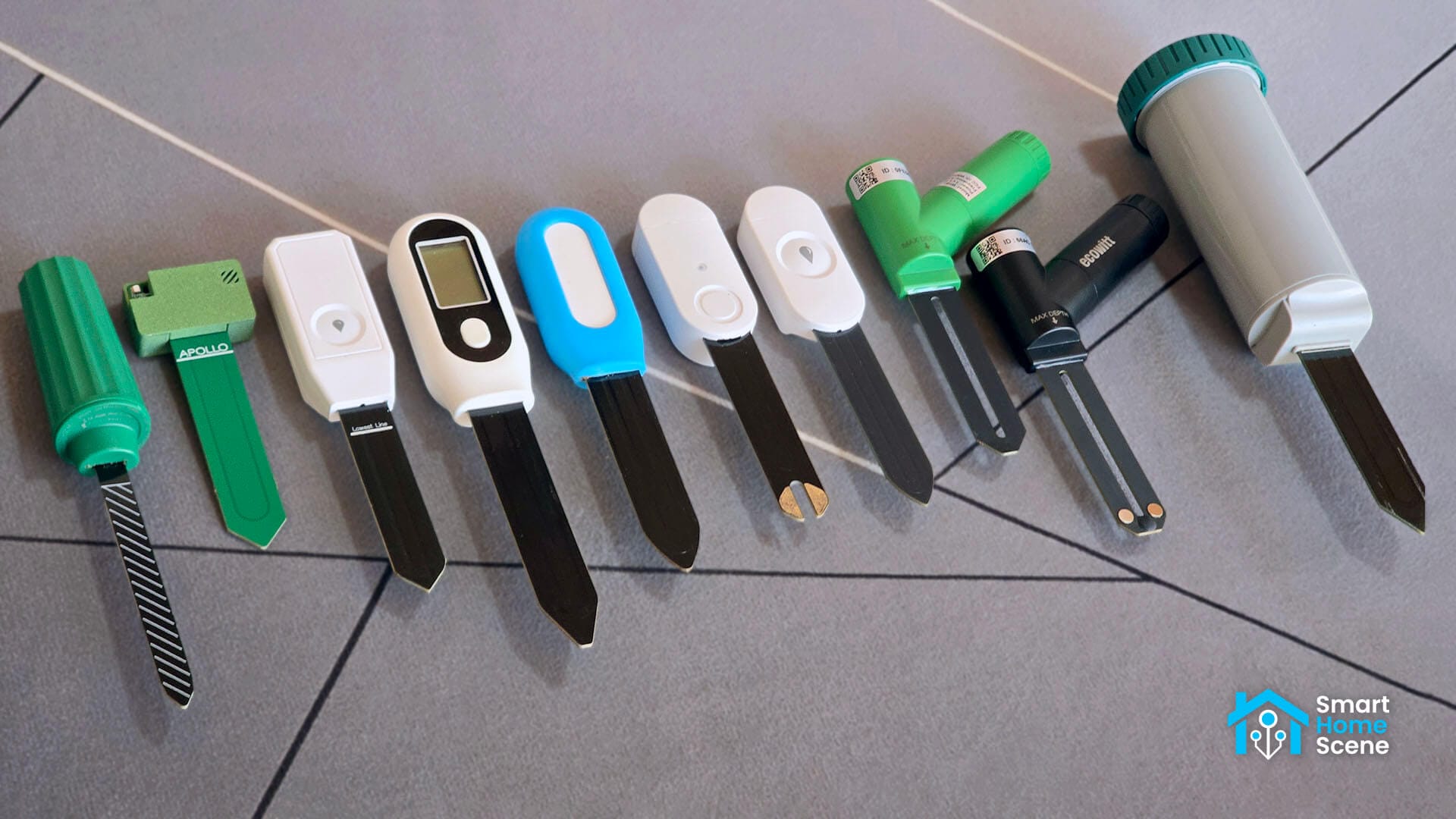
Seven of them use Zigbee, one runs ESPHome, and two come from the Ecowitt RF ecosystem. There is also a wider feature variance in this category. All of these report soil moisture, but some also measure soil temperature, air temperature, air humidity, light, or electrical conductivity. The specification table below shows exactly which sensor measures what, but my main focus in this comparison is their primary purpose: soil moisture.
For reference, I have also tested 6 AliExpress Zigbee door sensors and 10 AliExpress Zigbee smart buttons with the same hands-on approach.
Quick Picks: Overview
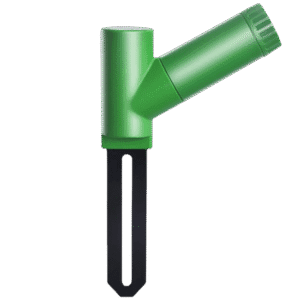
Ecowitt WH51
Best OVERALL
You want accurate, reliable soil moisture readings with long range RF connectivity for gardens or greenhouses.
Skip if
You do not want to buy an Ecowitt gateway or RTL dongle.
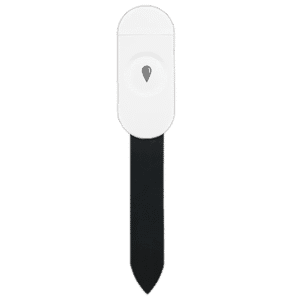
Tuya ZG-303Z
Best Zigbee
You want an accurate Zigbee sensor, with soil moisture, air temperature, humidity and firmware-level calibration.
Skip if
You need a sensor with an ingress rating for outdoor use.
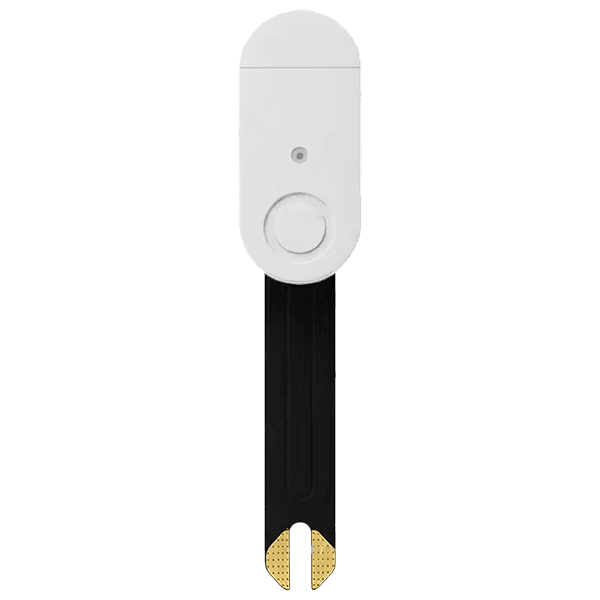
Tuya ZS-SF00
Best for FERTILITY
You need soil moisture, fertility, air temperature, air humidity, and light readings in one Zigbee sensor.
Skip if
You only need soil moisture and want a simpler sensor.
Testing Methodology
First of all, I paired the seven Zigbee sensors to Zigbee2MQTT through my SLZB-06MG24 coordinator. The Apollo Automation PLT-1 runs ESPHome, so it talks to Home Assistant over Wi-Fi. The two Ecowitt sensors report to a GW1200 gateway that runs on 433 MHz. As a result, all ten sensors are fully integrated into Home Assistant.
I tested the sensors for exactly 45 days, installed next to each other in a large flower pot. I watered the pot randomly, whenever I felt it was necessary, and I did not rely on any of the sensor readings. I was told this plant doesn’t need much water, so I rarely filled the pot. To make sure each sensor probe touched the water, I spread it around the pot when pouring.
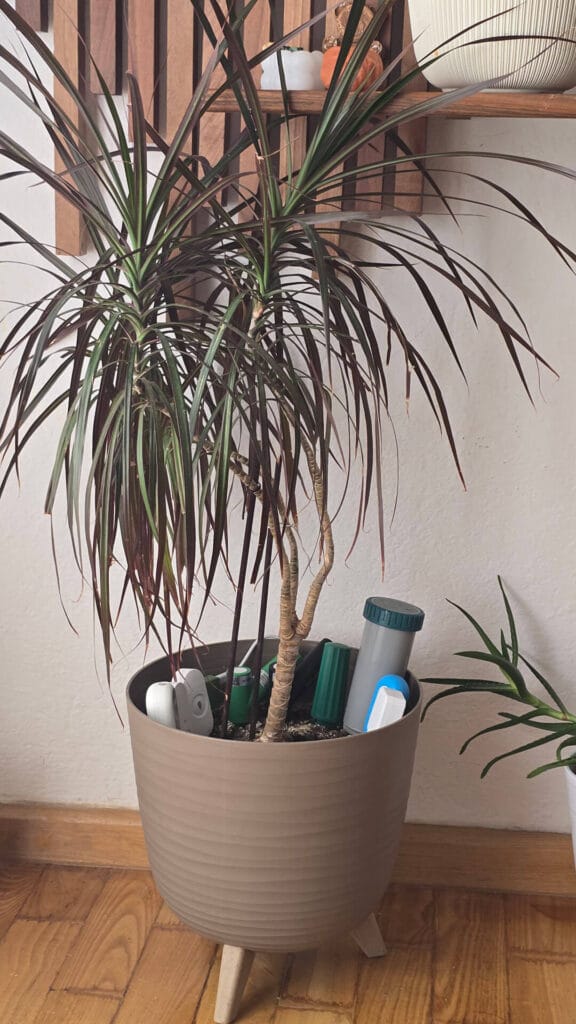
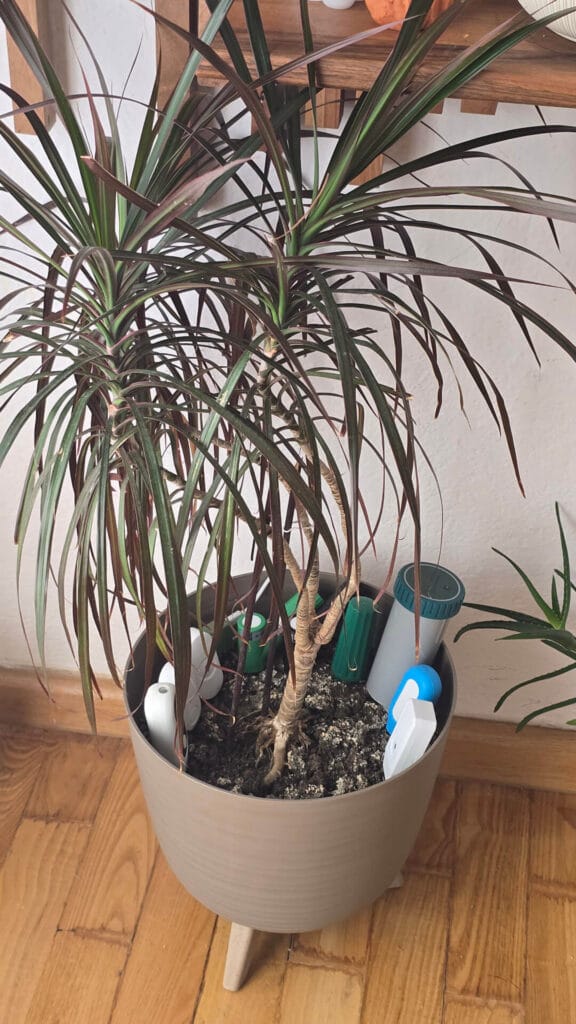
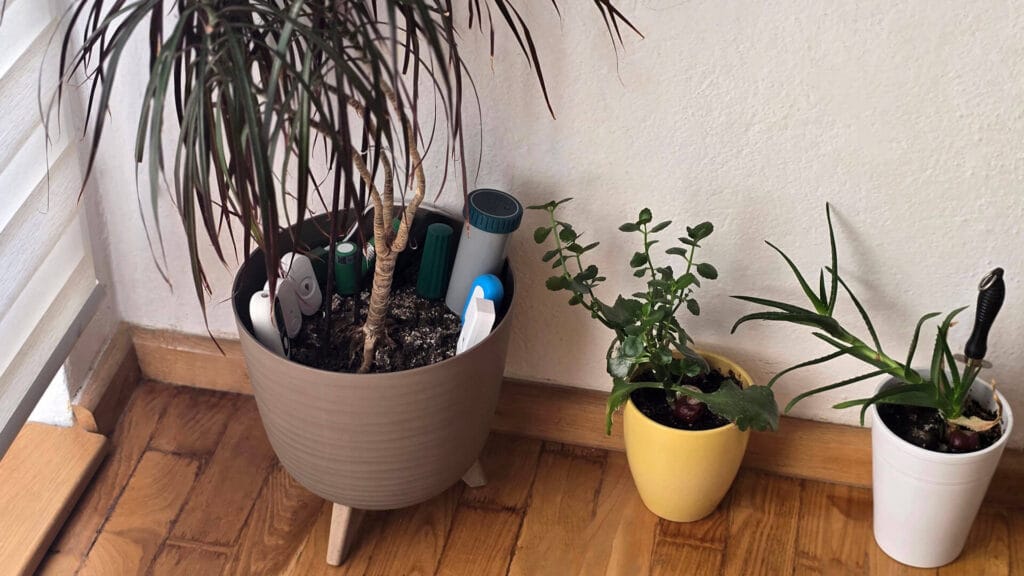
Models, Brands and Specifications
The table below lists every sensor with its brand, model, Z2M ID, and price. Tony ● is the ThirdReality Gen 1, the only version I had on hand. It is now hard to find, and its official successor is the ThirdReality Smart Soil Moisture Sensor Gen2. According to ThirdReality, the Gen 2 improves the probe, the enclosure, and the antenna. I did not test it, so my results below describe the Gen 1 only, and the price and buy links for Tony ● point to the Gen 2.
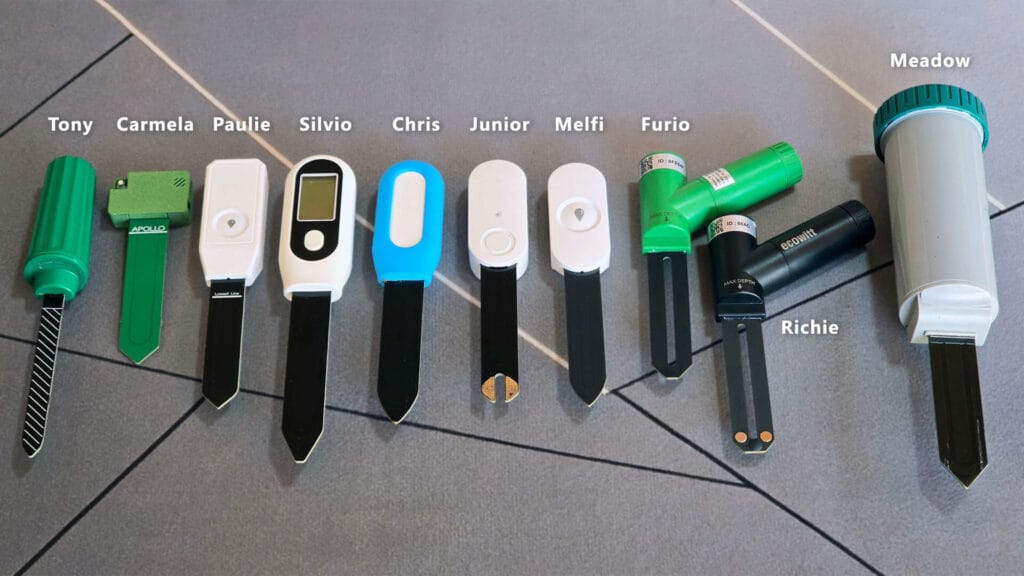
| Image | Code Name | Brand | Z2M Model | Price | Where to Buy |
|---|---|---|---|---|---|
 | Tony ● | ThirdReality 3RSM0147Z | ThirdReality 3RSM0147Z | From $19.99 | ThirdReality ● Amazon US ● Amazon UK Domadoo ● Amazon DE ● Amazon NL |
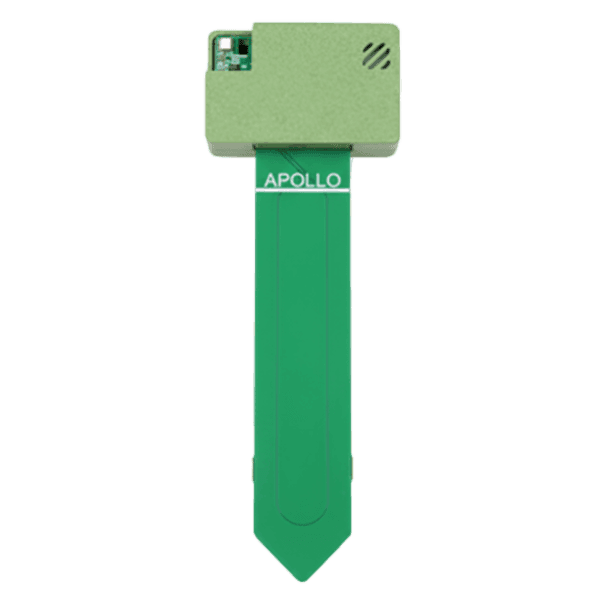 | Carmela ● | Apollo Automation PLT-1 | N/A | From $27.99 | Apollo Domadoo |
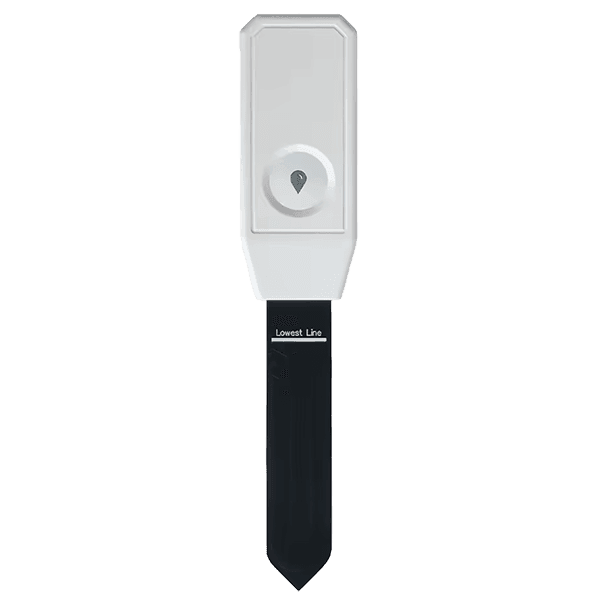 | Paulie ● | Tuya ZG-303Z | ZG-303Z Zbeacon | From $6.41 | AliExpress ● Amazon US ● Amazon UK AliExpress 2 ● Amazon DE ● Amazon NL |
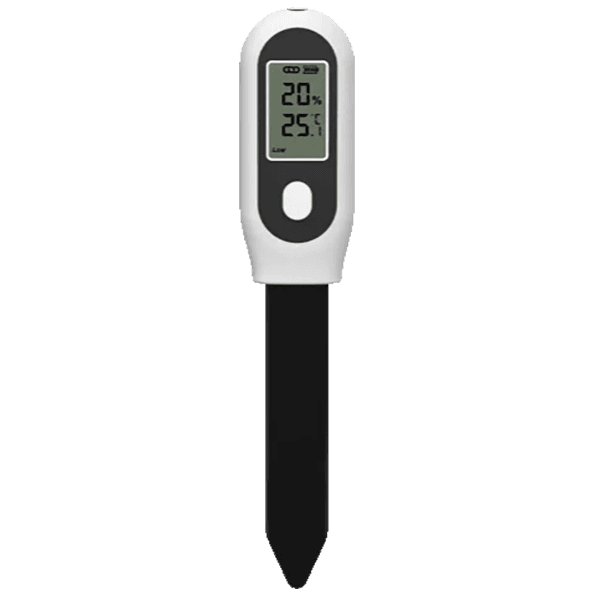 | Silvio ● | Tuya SGS02Z | TS0601 _TZE284_nt4pquef | From $11.36 | AliExpress ● Amazon US ● Amazon UK AliExpress 2 ● Amazon DE ● Amazon NL |
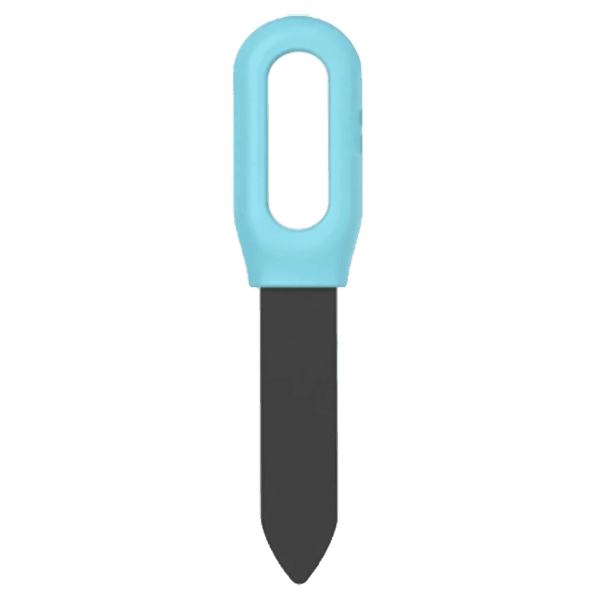 | Chris ● | Tuya SGS01 | TS0601 _TZE284_aao3yzhs | From $10.12 | AliExpress ● Amazon US ● Amazon UK AliExpress 2 ● Amazon DE ● Amazon NL |
| Junior ● | Tuya ZS-SF00 | Arteco A89G12C | From $7.03 | AliExpress ● AliExpress 2 AliExpress 3 ● AliExpress 4 |
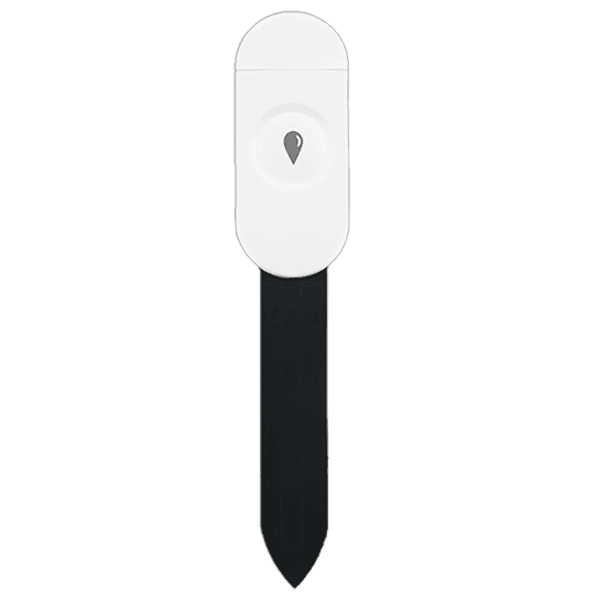 | Melfi ● | Tuya ZG-303Z | ZG-303Z HOBEIAN | From $5.78 | AliExpress ● Amazon US ● Amazon UK AliExpress 2 ● Amazon DE ● Amazon NL |
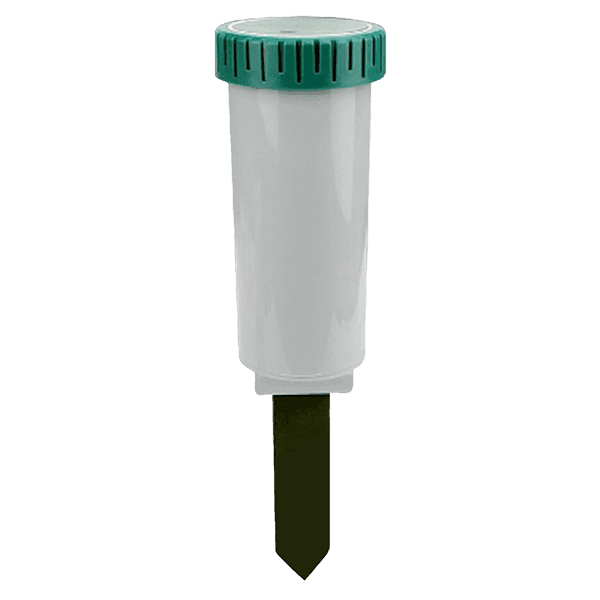 | Meadow ● | Tuya TS0201 | TS0201 _TZ3000_eamtuojw | From $33.91 | AliExpress ● Amazon US ● Amazon UK AliExpress 2 ● Amazon DE ● Amazon NL |
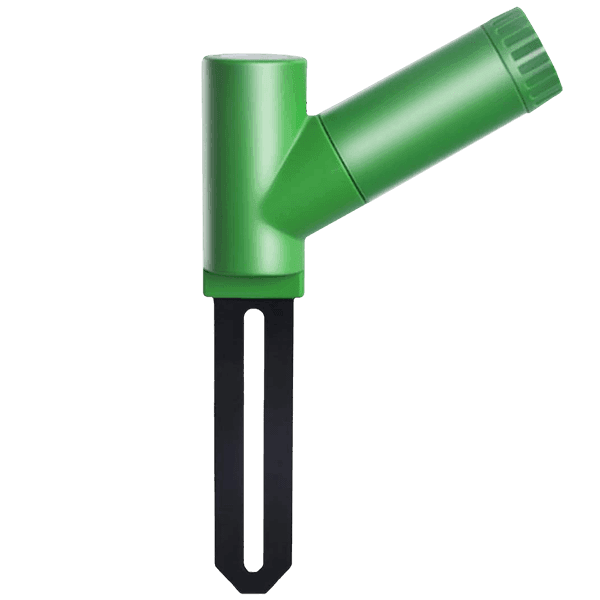 | Furio ● | Ecowitt WH51 | N/A | From $23.99 | AliExpress ● Amazon US ● Amazon UK Domadoo ● Amazon DE ● Amazon NL |
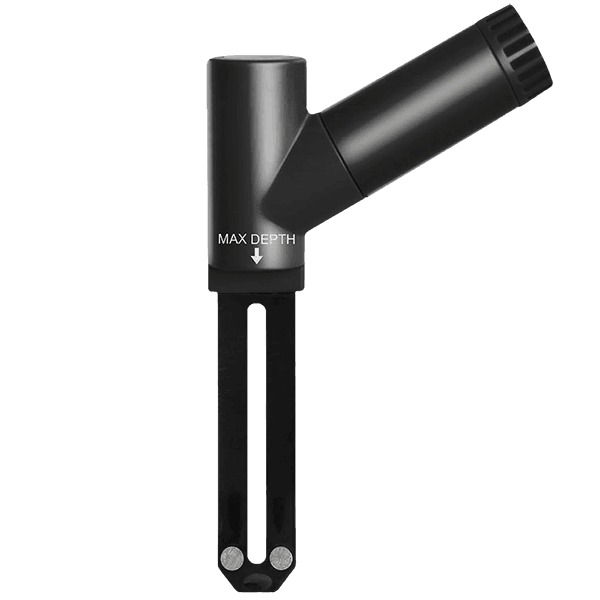 | Richie ● | Ecowitt WH52 | N/A | From $32.99 | AliExpress ● Amazon US ● Amazon UK Domadoo ● Amazon DE ● Amazon NL |
Technical Specification Table
This table collects every specification I have for each sensor, including which measurements it supports.
| Specification | Tony ● | Carmela ● | Paulie ● | Silvio ● | Chris ● | Junior ● | Melfi ● | Meadow ● | Furio ● | Richie ● |
|---|---|---|---|---|---|---|---|---|---|---|
| Battery | 1x AA | 5V 1A | 2x AAA | 2x AAA | 2x AAA | 2x AAA | 2x AAA | 4x AA | 1x AA | 1x AA |
| Body Length (mm) | 84.5 | 41 | 75 | 88.2 | 77.5 | 68 | 68 | 130 | 70 | 70 |
| Probe Length (mm) | 98 | 77 | 100 | 100 | 84.5 | 80 | 82 | 85 | 80 | 80 |
| Weight | 68 g | X | X | X | X | X | X | X | X | X |
| IP Rating | IP67 | – | – | – | IP66 | – | – | – | IP66 | IP66 |
| Soil Moisture | ✔︎ | ✔︎ | ✔︎ | ✔︎ | ✔︎ | ✔︎ | ✔︎ | ✔︎ | ✔︎ | ✔︎ |
| Soil Temp | ✘︎ | ✔︎ | ✘︎ | ✘︎ | ✘︎ | ✘︎ | ✘︎ | ✘︎ | ✘︎ | ✔︎ |
| Air Temp | ✔︎ | ✔︎ | ✔︎ | ✔︎ | ✔︎ | ✔︎ | ✔︎ | ✔︎ | ✘︎ | ✘︎ |
| Air Humidity | ✘︎ | ✔︎ | ✔︎ | ✘︎ | ✘︎ | ✔︎ | ✔︎ | ✘︎ | ✘︎ | ✘︎ |
| Illuminance | ✘︎ | ✔︎ | ✘︎ | ✔︎ | ✘︎ | ✔︎ | ✘︎ | ✘︎ | ✘︎ | ✘︎ |
| EC | ✘︎ | ✘︎ | ✘︎ | ✘︎ | ✘︎ | ✔︎ | ✘︎ | ✘︎ | ✘︎ | ✔︎ |
| Moisture Range | 0-100% | 0-100% | 0-100% | 0-100% | 0-100% | 0-100% | 0-100% | 0-100% | 0-100% | 0-100% |
| Moisture Accuracy | ±3% | ±5% | – | – | – | – | – | – | ±5% | ±5% |
| Moisture Resolution | 0.01% | 0.1% | 1% | 1% | 1% | 1% | 1% | 1% | 1% | 1% |
Size and Form Factor
The Ecowitt sensors, Furio ● and Richie ● have a unique form factor. The angled body looks and feels a bit like a gun, and I like how it sits in the hand. That does not really matter once they are in the soil, but it is a nice ergonomic touch.
Meadow ● is the ugliest and worst shaped sensor I have, and it is not even close. It is huge, with a 130 mm x 55 mm body size and an 85 mm probe, so it looks like a repurposed drain pipe next to the others. I do not think the four AA batteries it takes justify that size. It simply looks out of place once installed in a pot.
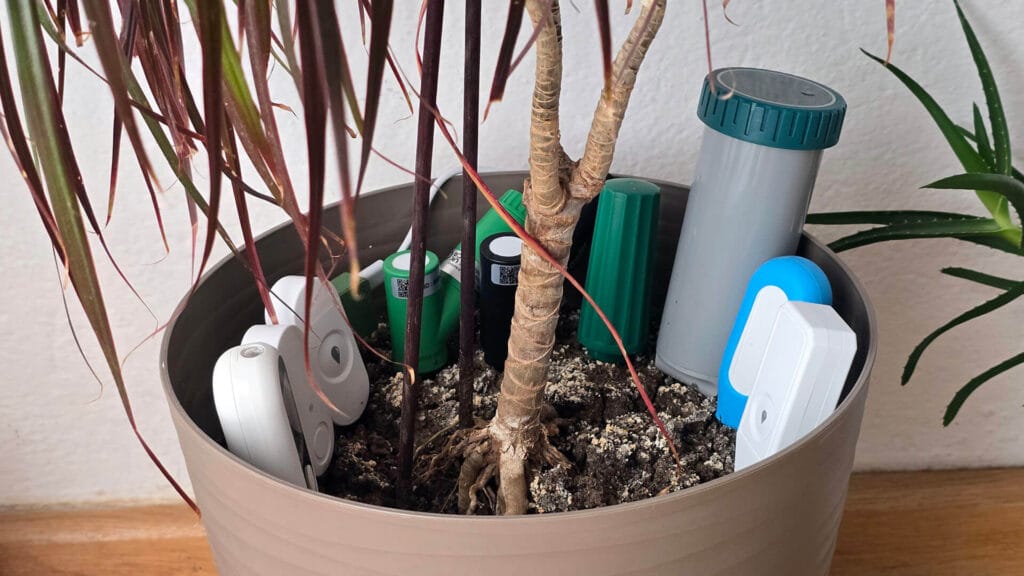
On the other end, Carmela ● is the smallest sensor which also sits closest to the soil. This makes it my pick for hiding inside a pot, as long as you also plan how to hide the cable. The battery version, the Apollo PLT-1B, is larger, but I do not have it here, so it is not part of this review.
Tony ●, Chris ●, and Melfi ● have the best shapes and sizes in my opinion. They are straight, ergonomic, not too large, and they look nice in a pot. Melfi ● and Junior ● are the smallest Zigbee sensors, with Paulie ● and Chris ● only slightly longer.
Build Quality and Weather Resistance
The build quality is surprisingly good on all the AliExpress sensors. Melfi ●, Paulie ●, Chris ●, and Junior ● all feel compact and well made. Nothing wiggles and nothing moves around, so they feel solid and well built. Meadow ● is again the exception, since it is huge and does not feel well made. It feels heavy, yet strangely empty inside at the same time.
Silvio ● also looks good, but I find its screen counterintuitive. You bury the sensor halfway into the pot, and then you have trouble seeing what is on the screen. I also expect its battery life to suffer, since two AAAs have to power a screen on top of the sensor and the MCU.
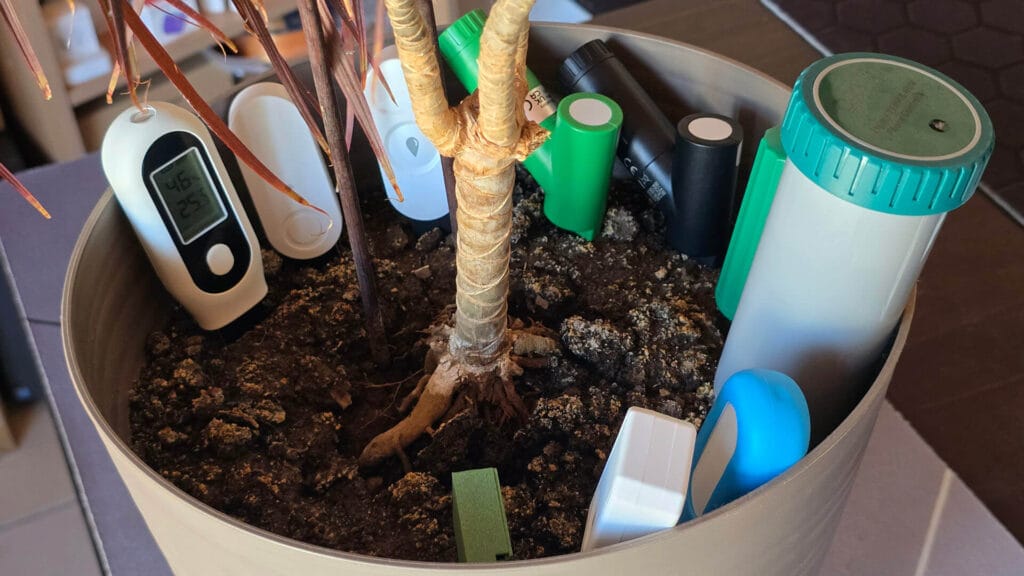
When it comes to weather resistance, only four sensors have an ingress rating that I could find and verify. Tony ● is rated IP67, while Chris ●, Furio ●, and Richie ● are rated IP66. I treat the other six as having no ingress rating, which means they are only suitable for indoor use. You might be able to protect them with a plastic bag or a special 3D printed enclosure, but that is beyond the purpose of this review.
Tony ● has the best protected body of the group, and it is the sensor I would trust the most with pouring water. There are no seams or joints anywhere, because the top is one solid piece that screws onto the probe part and covers everything in between. You will not get it soaked even if you pour water on top of it.
Furio ● and Richie ● are trickier to protect, even if you install them outdoors. They include two rubber covers, one for the top and one for the angled top, to keep water out. Still, a simple straight shape is naturally more resistant to water damage, since water drops to the sides and slides over it, so the angled design works against them here.
Carmela ● has no ingress rating whatsoever, so it is the one that needs your attention the most. You need to think about protecting it from rain and from simple watering, because even small splashes can get inside the electronics and damage them.
Overall, Tony ● is the best protected, and Furio ● and Richie ● are decent but need their covers installed properly. Carmela ● definitely belongs indoors, and Meadow ● is the only sensor whose build quality is completely inadequate.
Battery Type and Expected Battery Life
Tony ●, Furio ●, and Richie ● run on a single AA battery. Paulie ●, Silvio ●, Chris ●, Junior ●, and Melfi ● use two AAA batteries, and Meadow ● takes four AA batteries. Carmela ● is the wired version and uses no battery. Ecowitt claims a battery life of at least 12 months for Richie ●, and the Chris ● listing claims a standby time of 8 to 12 months.
I have not tested battery life for any of these sensors, since I have not had them for long enough. As I repurpose old batteries during my testing, the battery level reporting in Home Assistant should also be considered inaccurate. Still, my experience with similar devices tells me the Zigbee sensors should last up to a year, as long as everything is configured properly and there are no issues like too frequent reporting.
Home Assistant Integration and Pairing
As I mentioned earlier, the ten sensors reach my Home Assistant server through three different routes. Zigbee2MQTT handles seven of them, ESPHome handles one, and an Ecowitt gateway with the Ecowitt Local community integration handles the last two.
Zigbee2MQTT
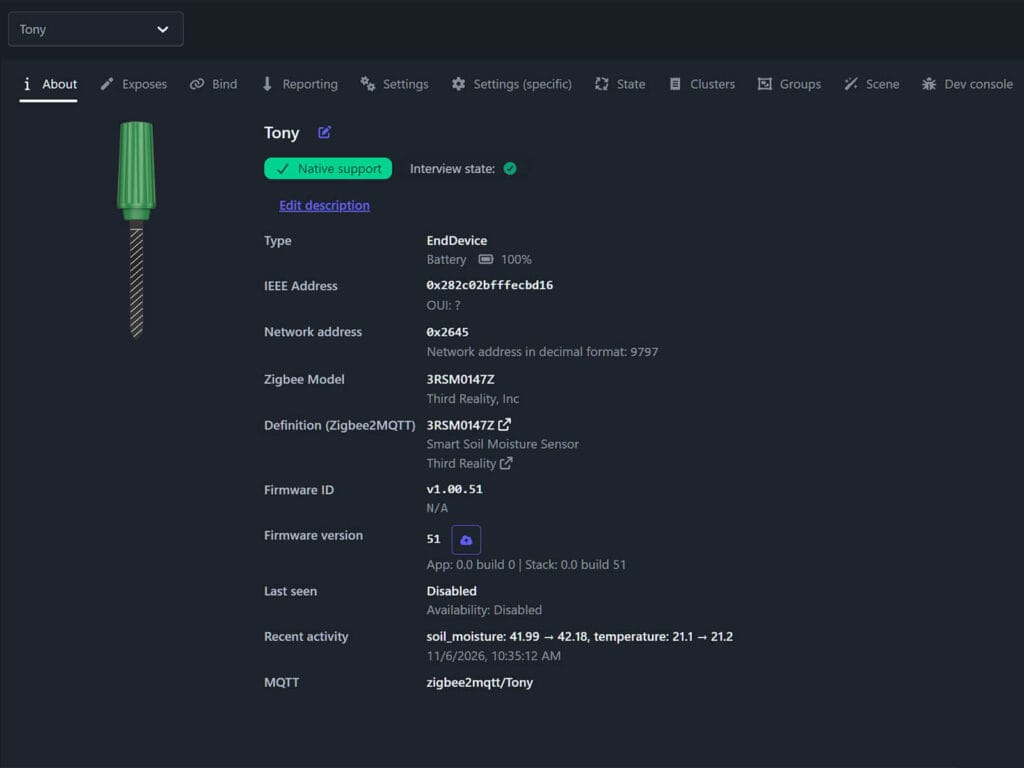
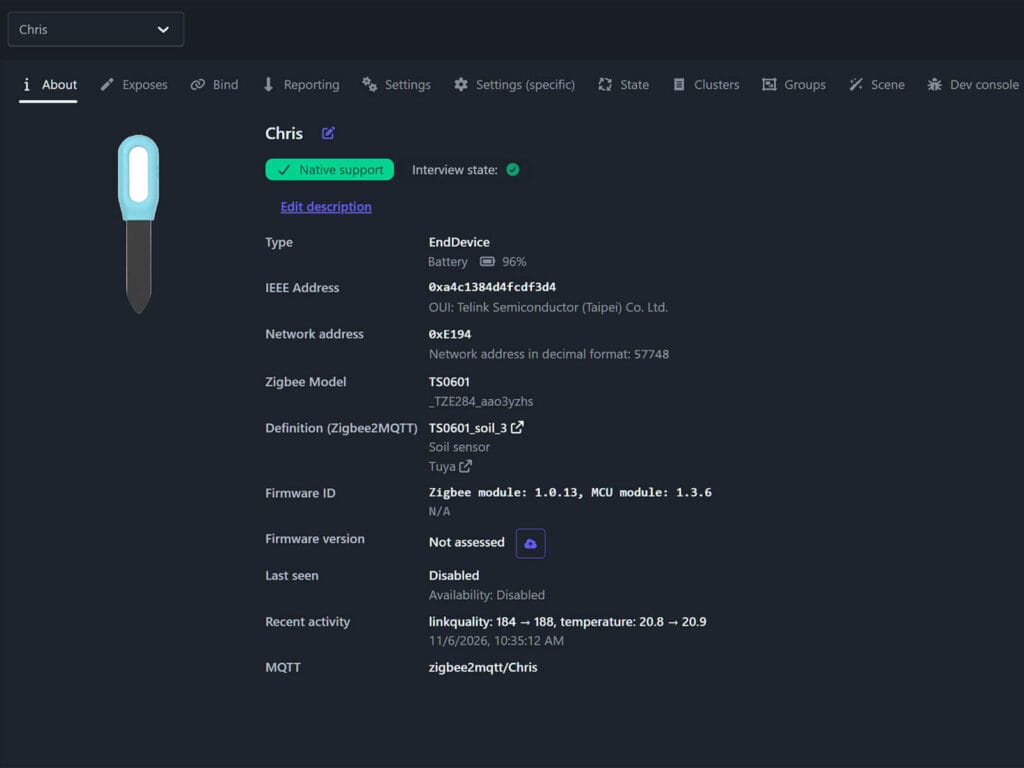
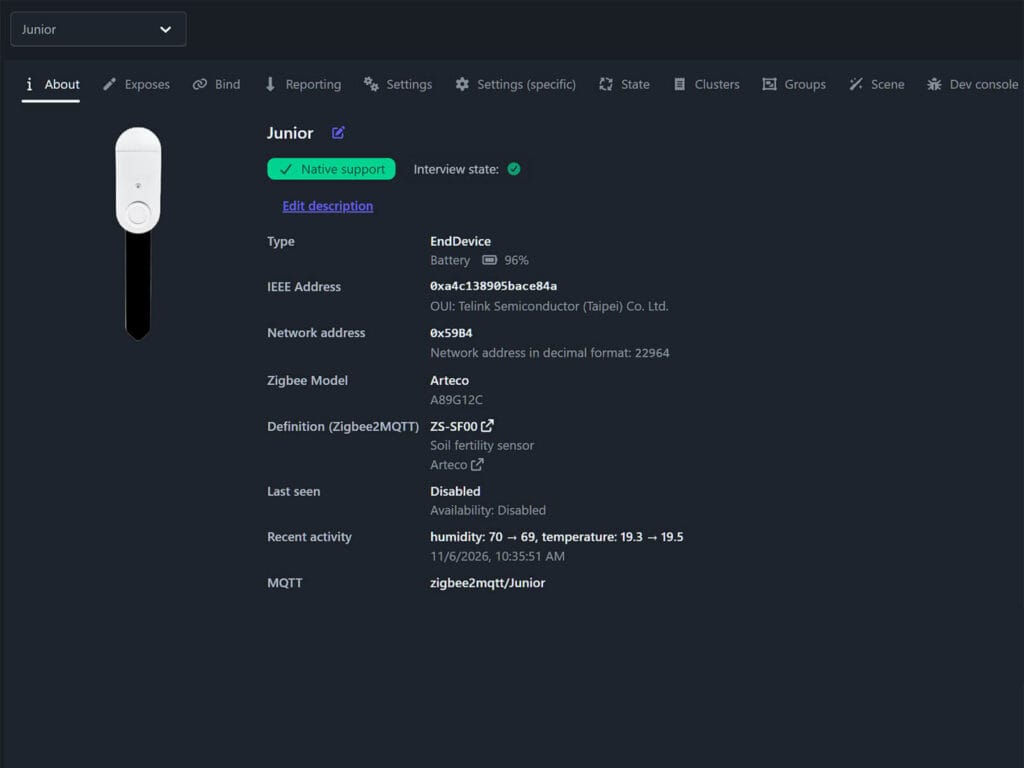
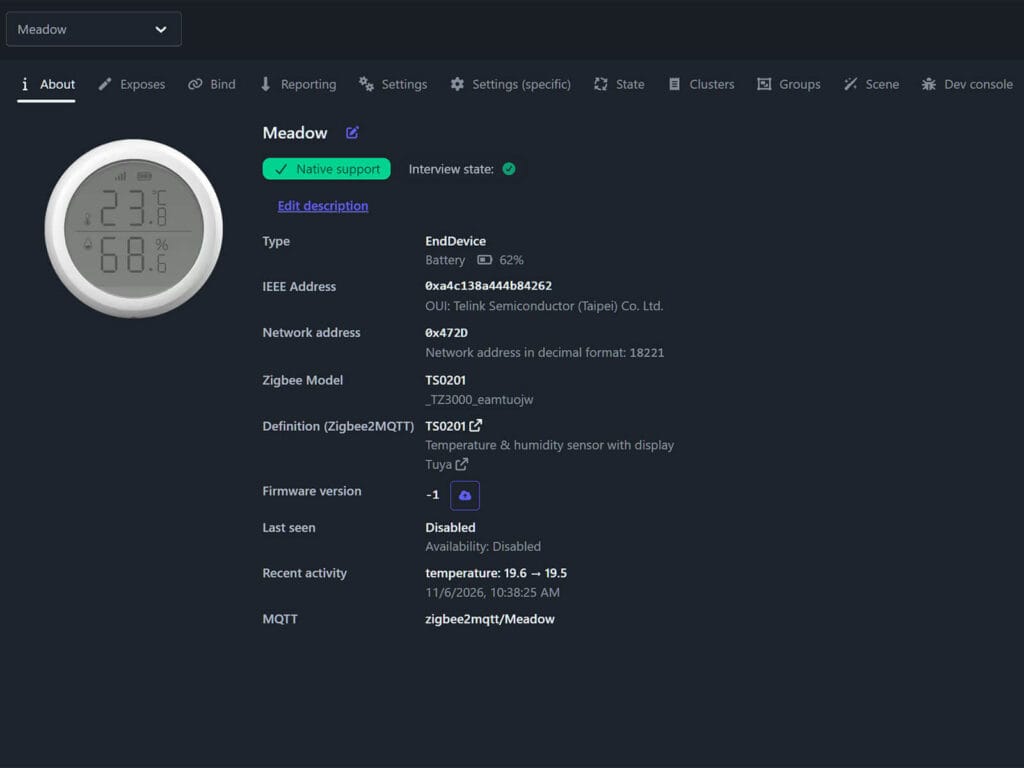
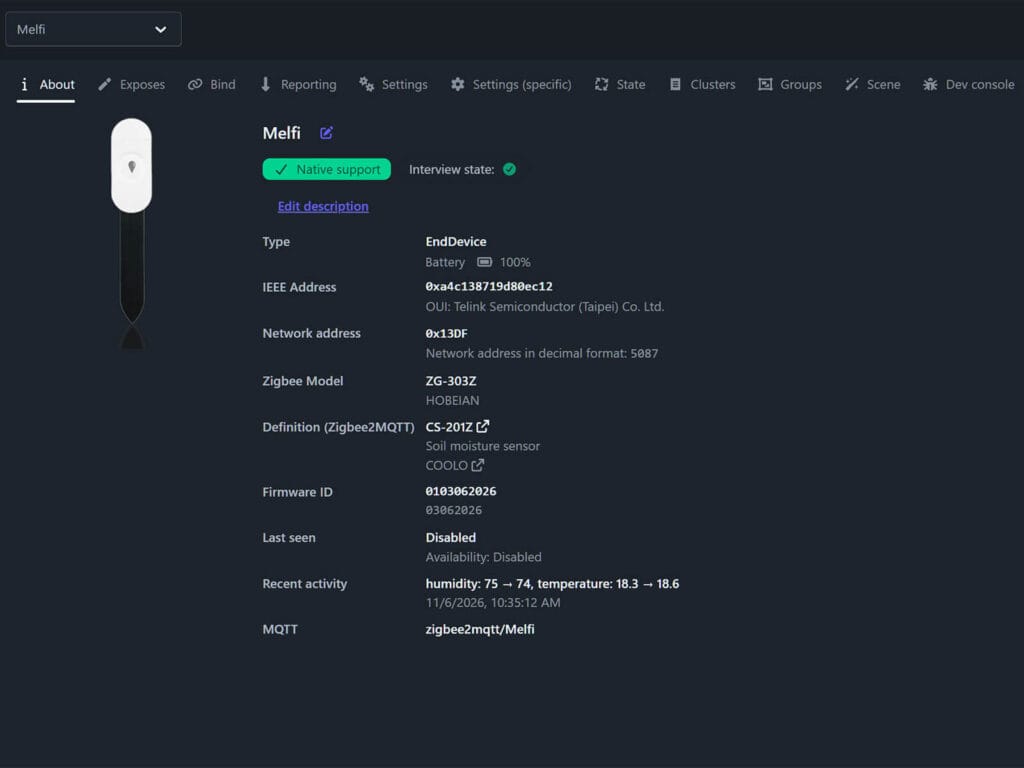
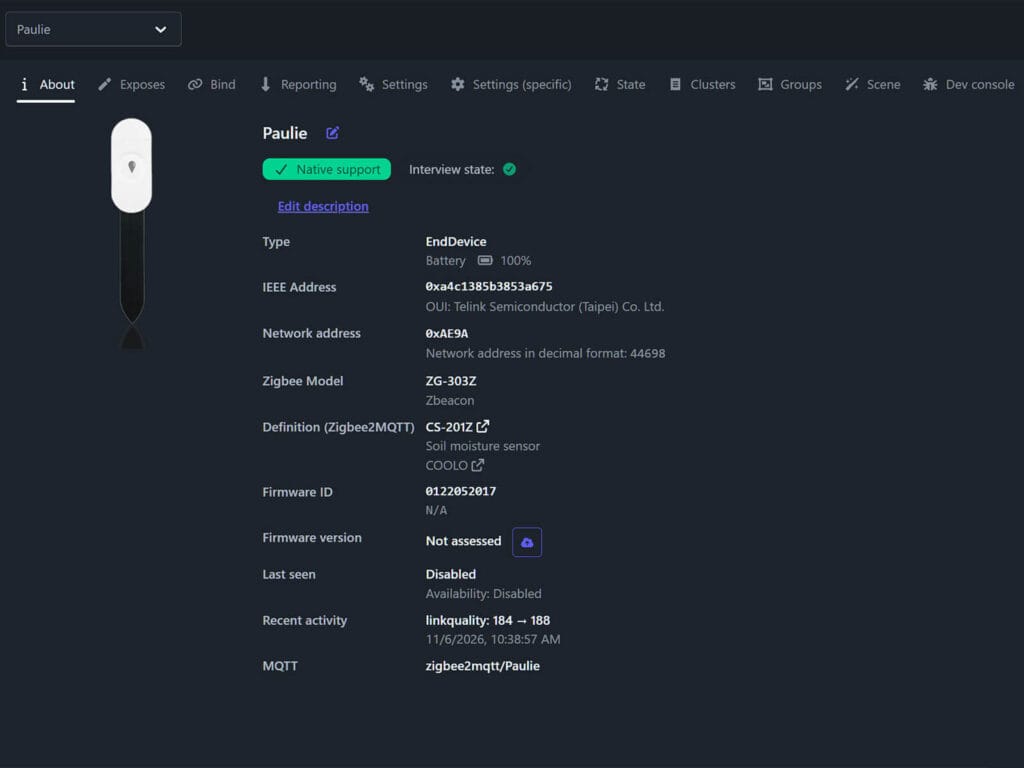
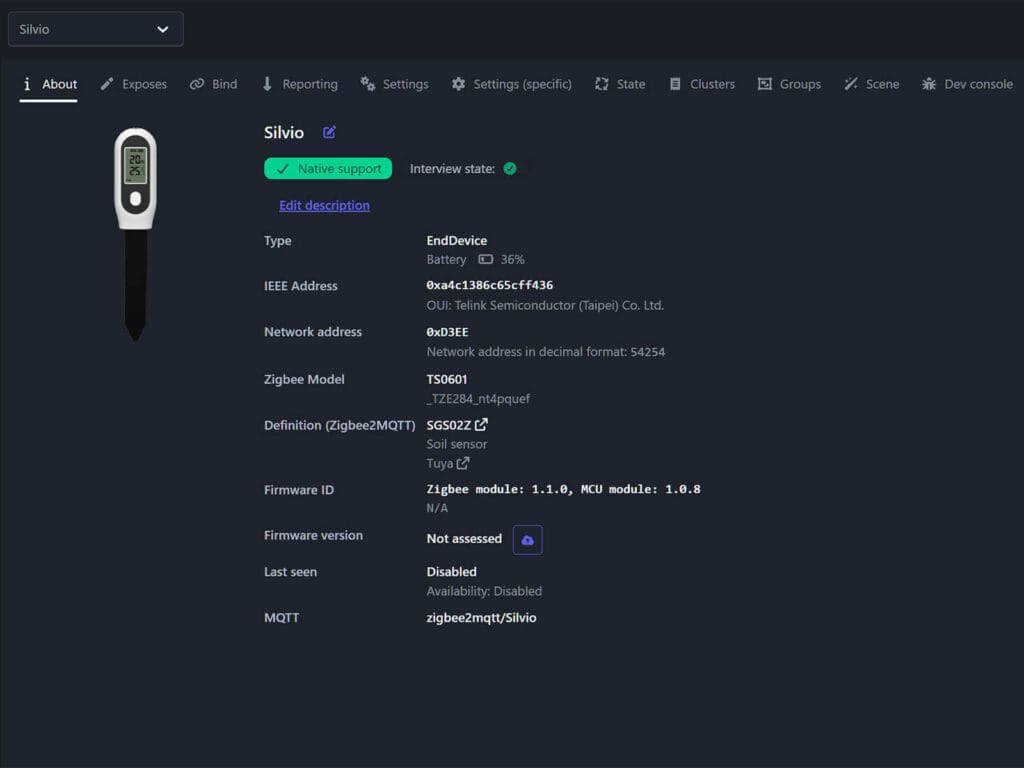
All seven Zigbee sensors paired with Zigbee2MQTT without any trouble. Every one of them joined as an end device, which is expected for battery powered sensors, so none of them help extend the mesh. The battery level and the chip type are visible right after pairing, which makes it easy to confirm what you actually bought.
Zigbee2MQTT matches Tony ● to the 3RSM0147Z definition, Silvio ● to SGS02Z, Chris ● to TS0601_soil_3, and Junior ● to ZS-SF00. Paulie ● and Melfi ● both match the ZG-303Z definition, even though they are different devices. This is very common in Tuya Zigbee devices, because two can share the MCU and identify with the same ID in Zigbee2MQTT and Home Assistant.
Meadow ● is the only exception, because it matches the wrong converter. As a result, its soil moisture is reported ten times too low, for example as 5.5% when the real value is 55%. You need to multiply the value by 10 to correct it. It is an easy fix, and the device does report properly with that offset, but it is the one sensor here that needs extra work before you can trust it.
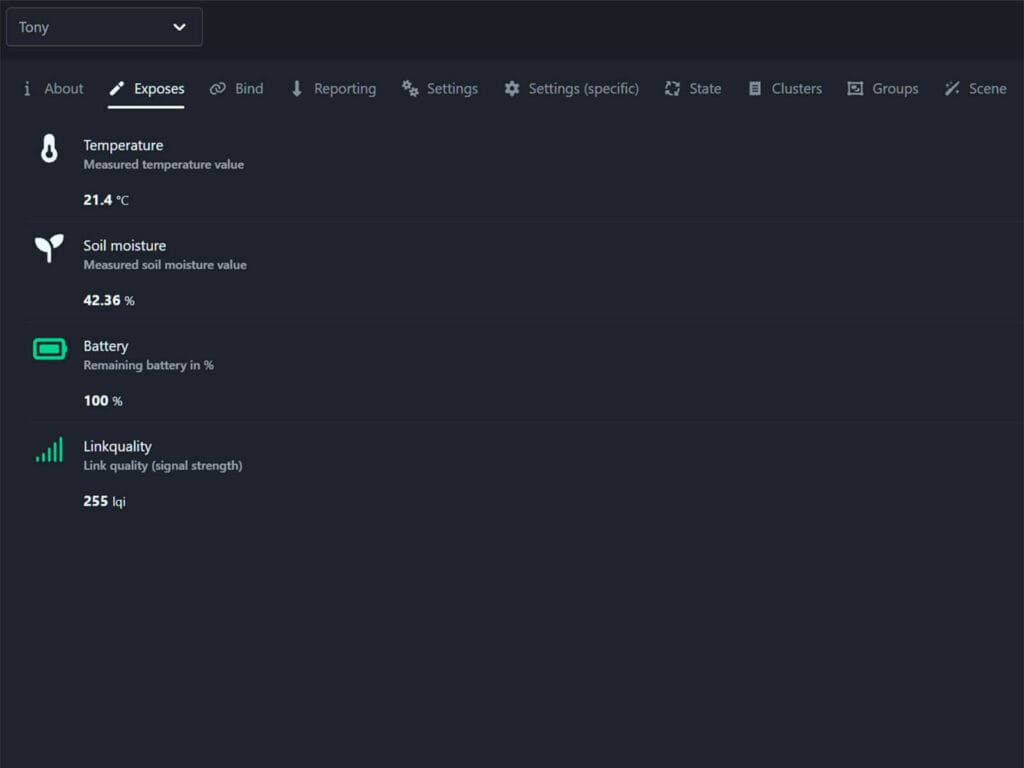
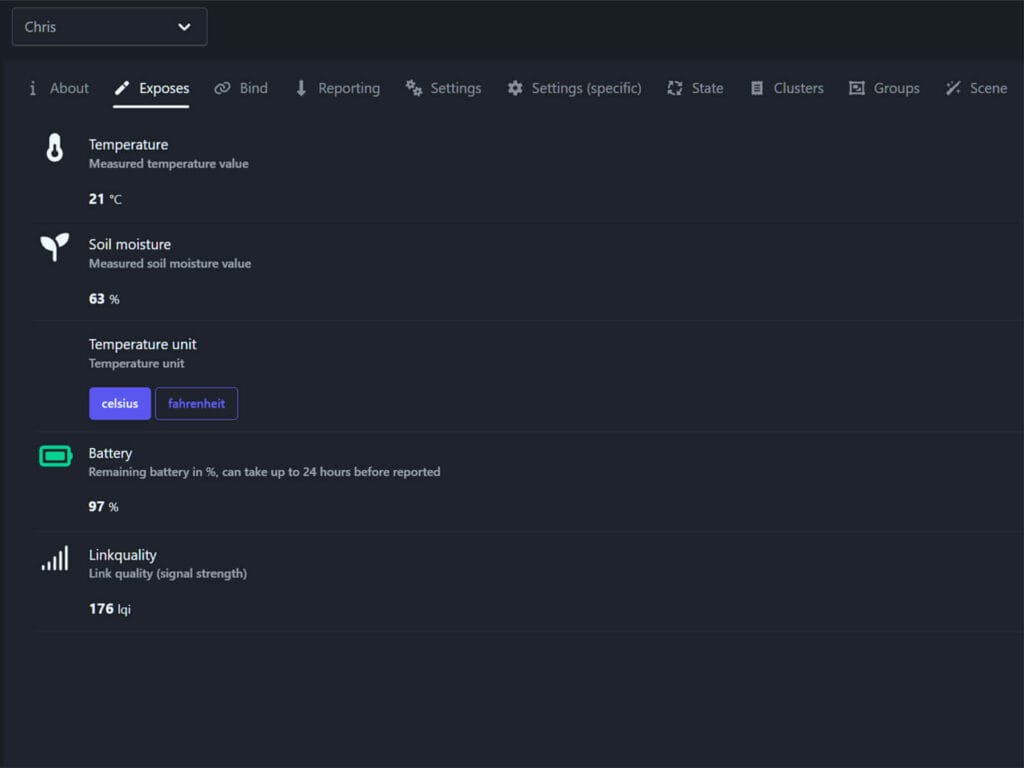
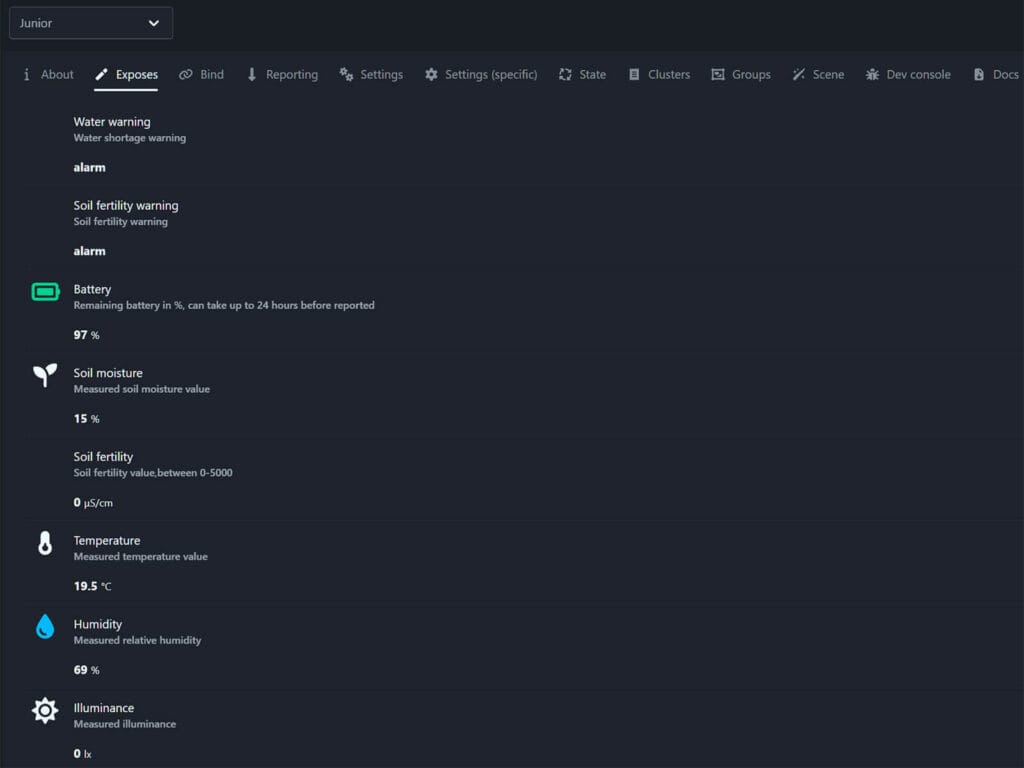
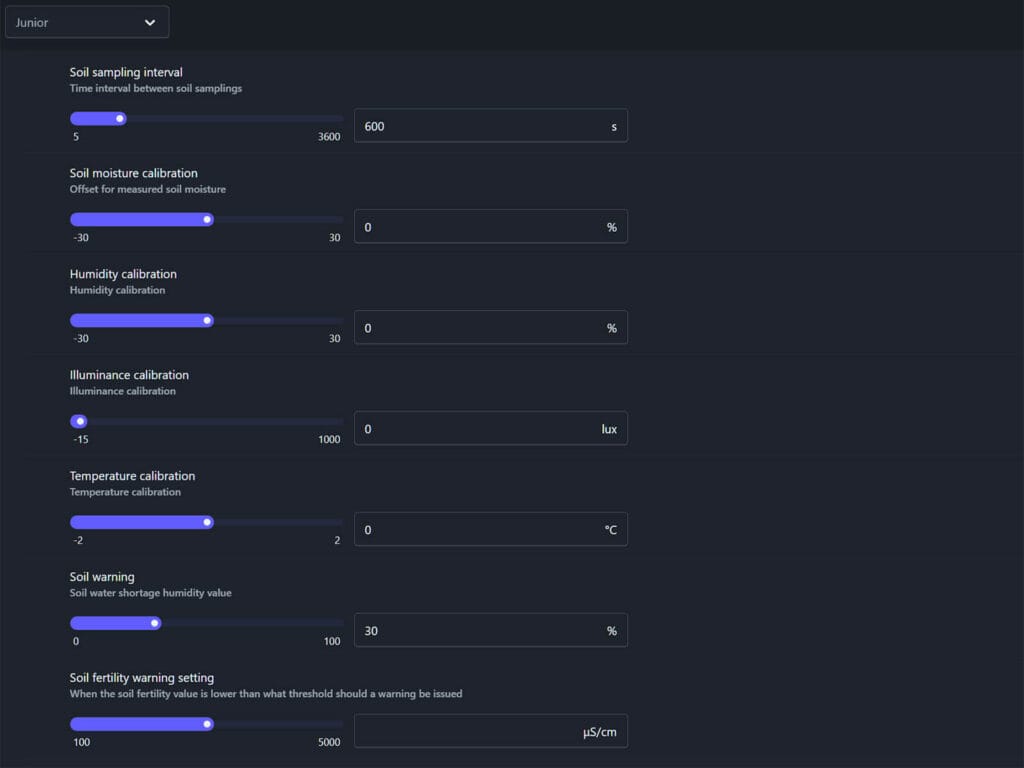
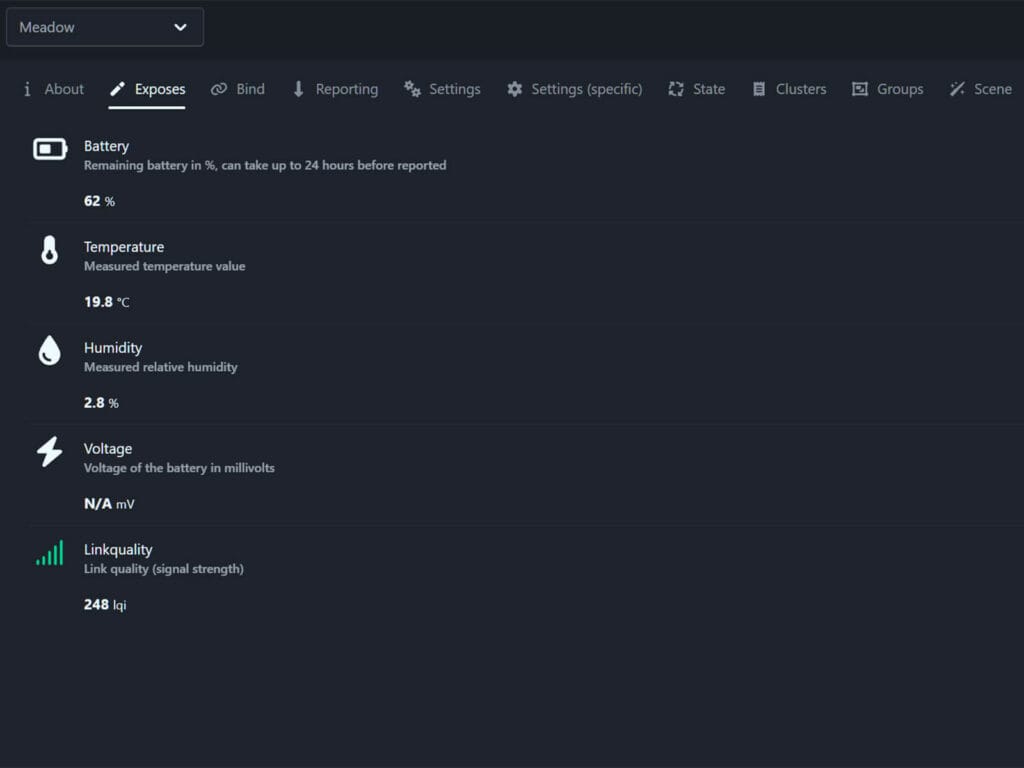
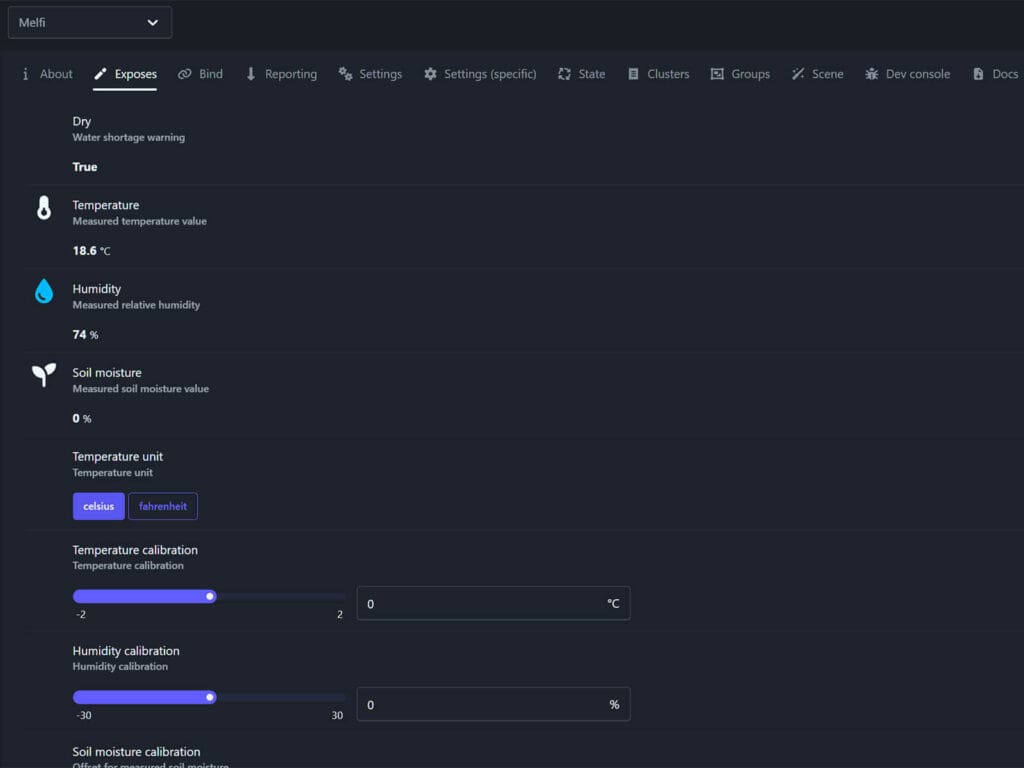
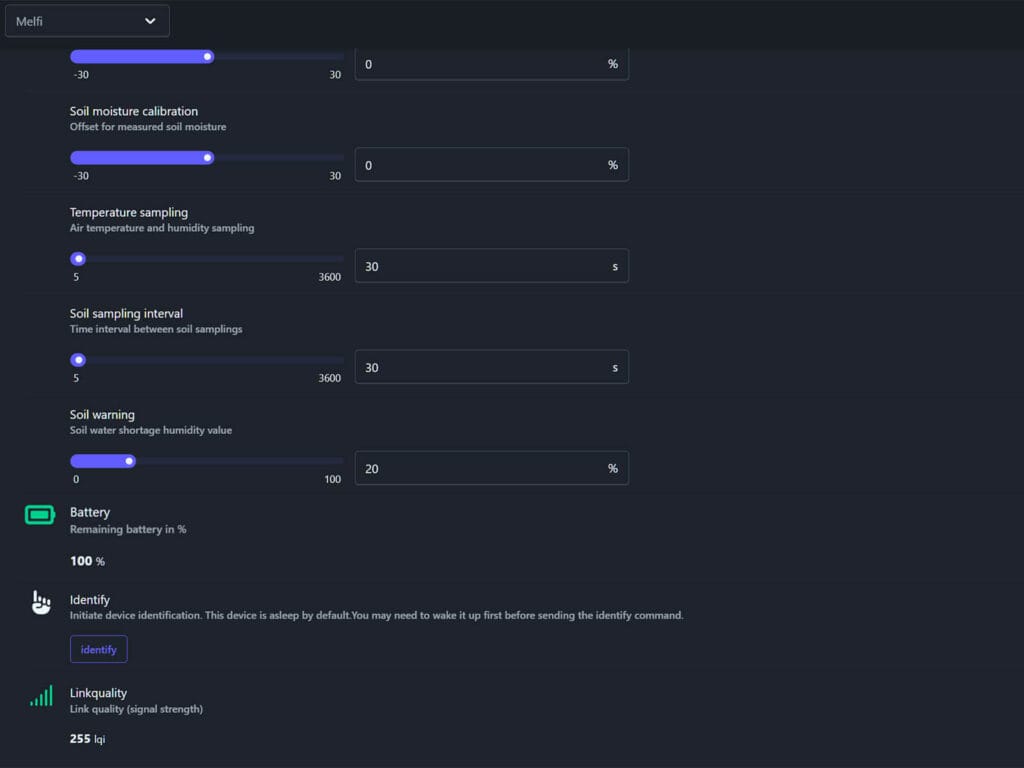
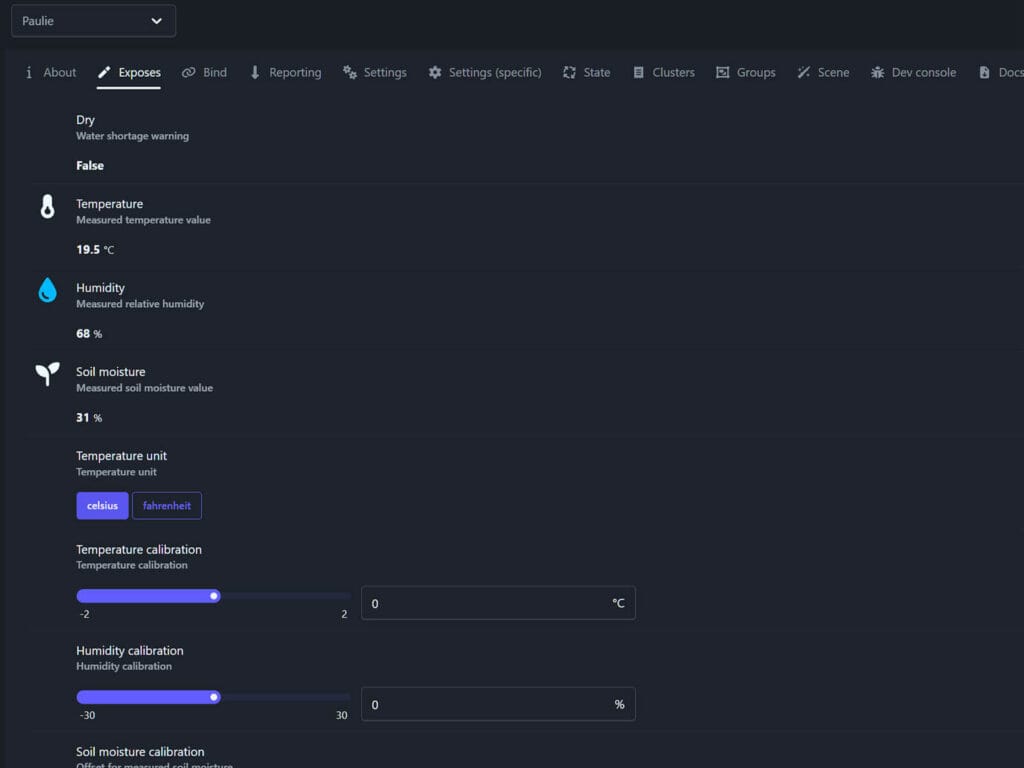
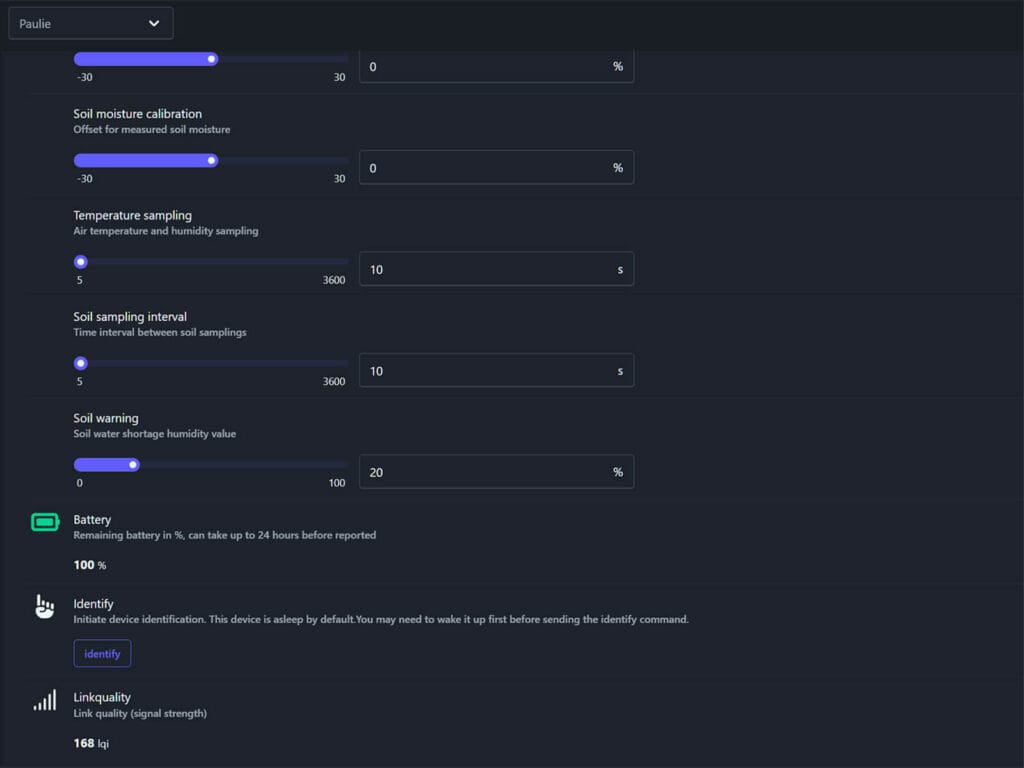
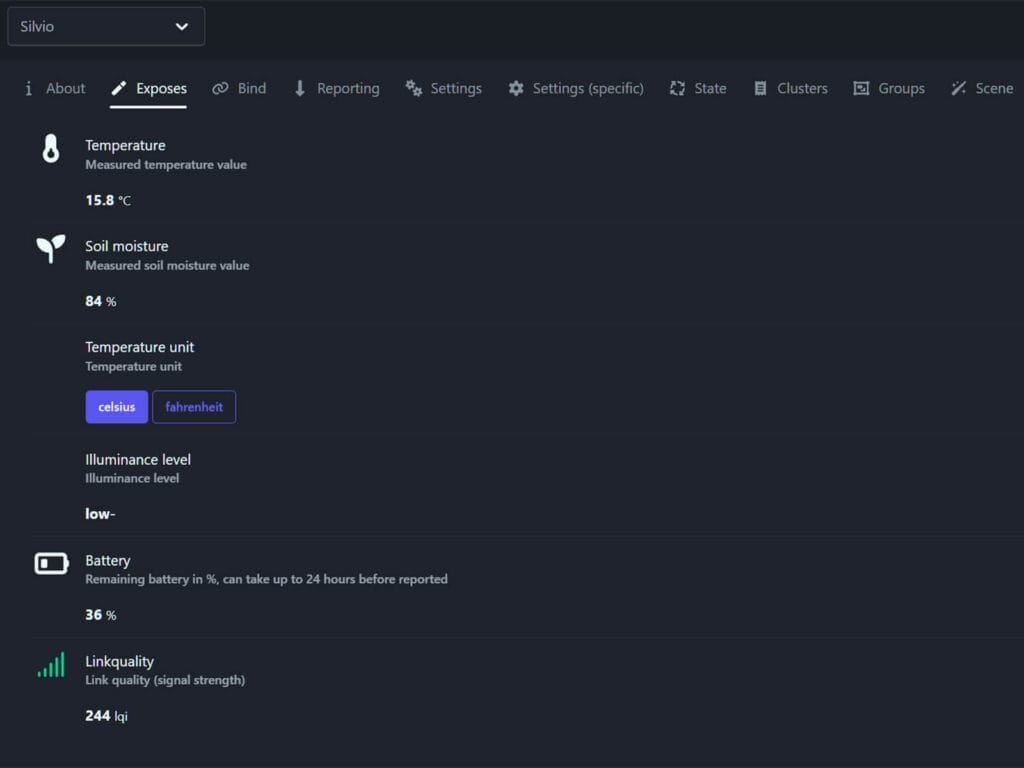
Obviously, every sensor is built around the main feature, which is soil moisture. The rest of what they expose is a nice bonus, and I treat it as such when considering any of these. Tony ● and Chris ● keep it simple and add only air temperature on top of soil moisture and battery. Silvio ● adds a rough illuminance level hint, but it is only low-medium-high range and not a real measurement.
Paulie ● and Melfi ● expose much more than the others, and I like that Zigbee2MQTT lets you tune them. You get calibration offsets, separate sampling options, a dry alarm sensor, and a soil warning threshold. The calibration is the useful part, because you can correct a sensor that reads a bit off.
Junior ● is the most interesting sensor in the group because it is a soil fertility sensor and I purposefully bought it like that. Besides soil moisture, it measures soil conductivity, which gives a rough idea of how many nutrients and salts are in the soil. This matters if you fertilize your plants, since you can see when the soil is running low or when you have overdone it. It also reports air humidity and illuminance, and it has separate warnings for water shortage and low fertility. In my view, this is the only sensor here that gives you a real reason to look beyond plain soil moisture, if that is what you are looking for.
Meadow ● exposes the least useful data of all. Its soil reading shows up as humidity because of the wrong converter, and its voltage field is empty. Overall, I would pick a sensor for its soil moisture first and treat everything else as a nice extra.
ESPHome
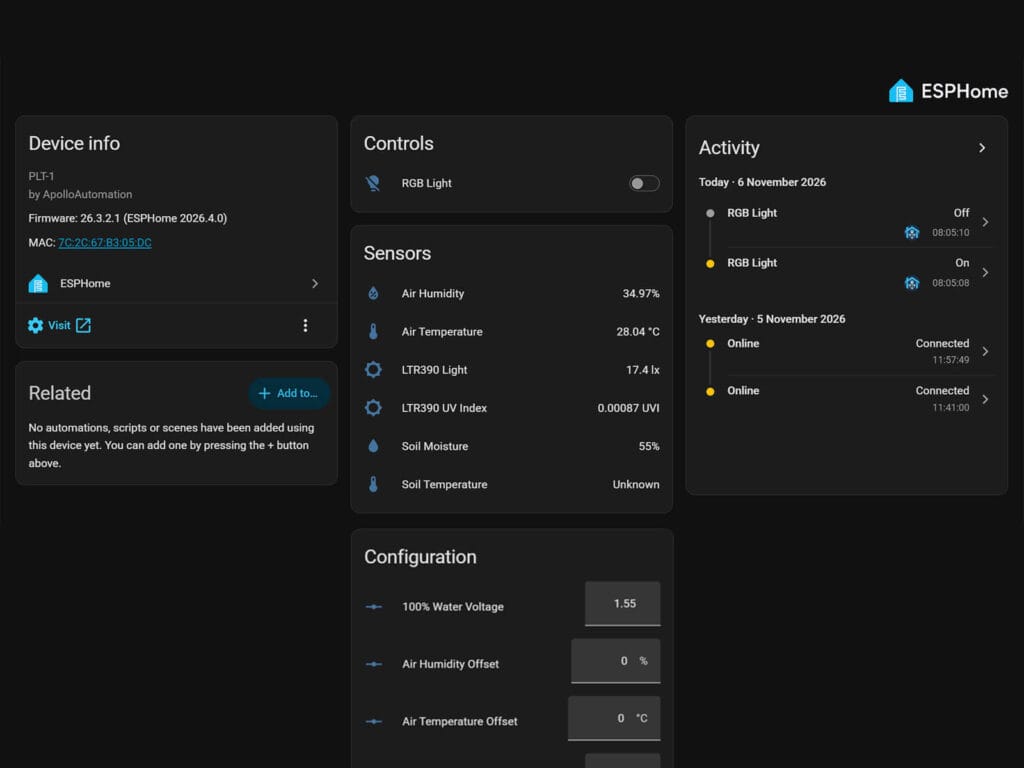
Carmela ●, the Apollo PLT-1, runs ESPHome and integrates in Home Assistant through the ESPHome integration. It uses a capacitive soil moisture sensor that the ESP32-C3 reads through its ADC. It exposes soil moisture, temperature, air humidity, air temperature, illuminance level, UV index and a bunch of calibration entities. The moisture value needs manual calibration in Home Assistant for the best precision.
I tested the PLT-1 wired version, which has no battery. The optional Dallas temperature probe plugs into the dedicated barrel port and adds soil temperature. The sensor also has an onboard piezo buzzer and an addressable RGB LED.
Ecowitt Local
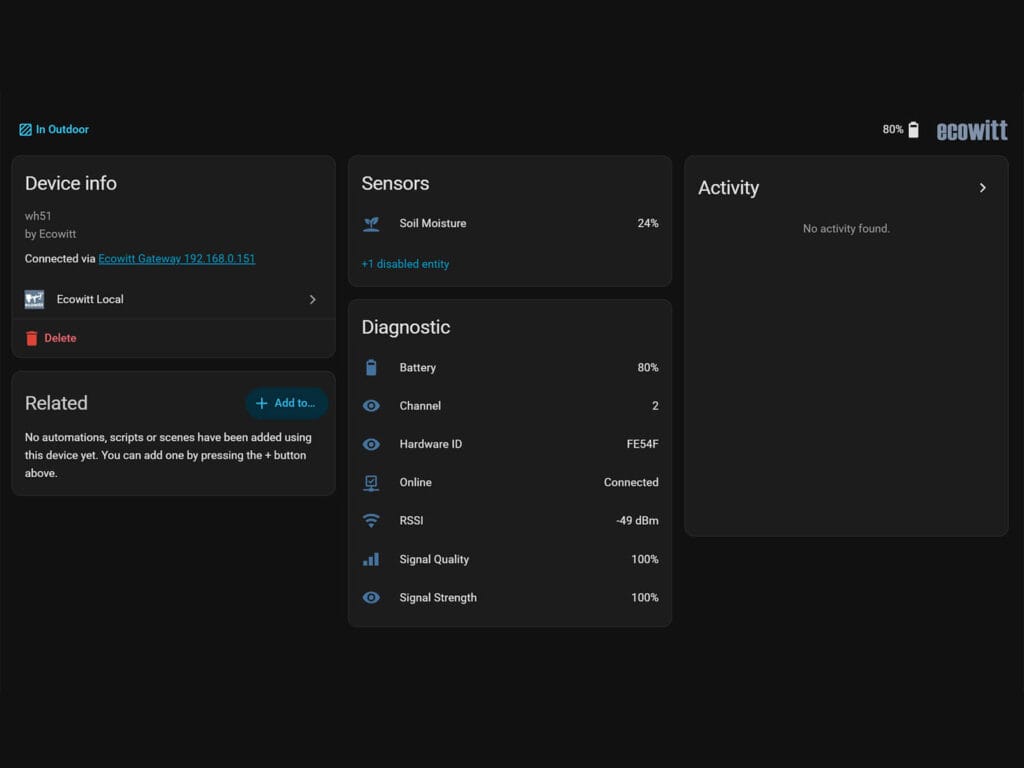
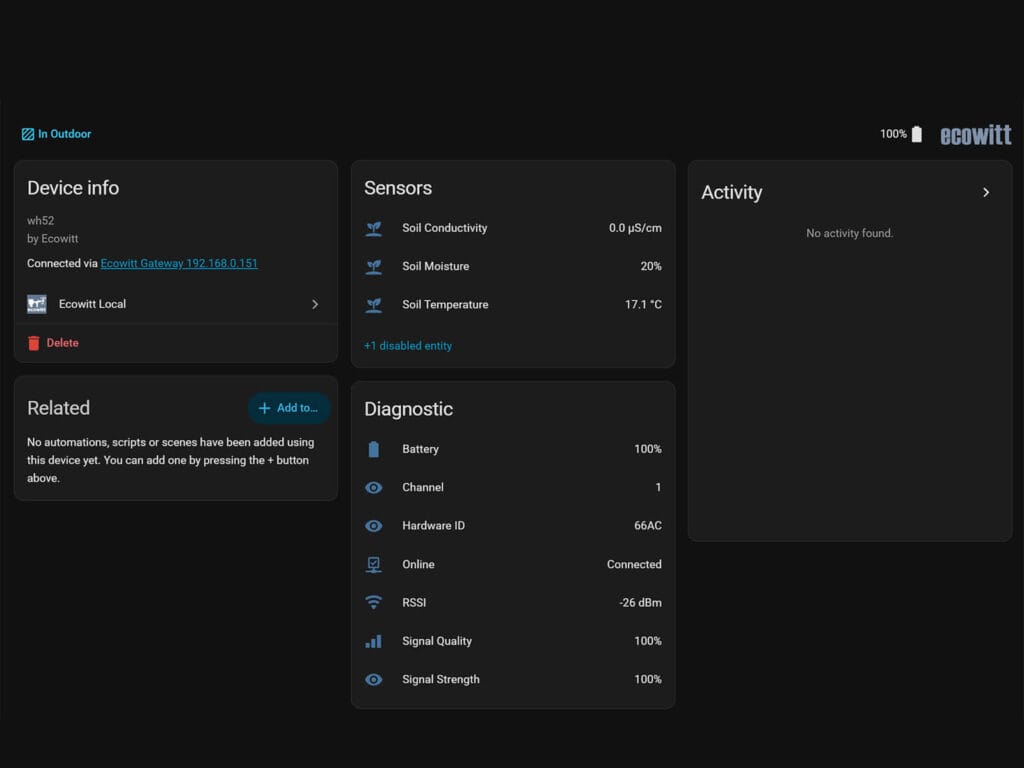
Furio ● and Richie ● do not talk to Home Assistant directly. They transmit by radio to an Ecowitt GW1200 gateway, which you can integrate in Home Assistant. You can do this in a couple of ways. With the built-in Ecowitt integration, which receives data through a webhook push from the gateway or with the Ecowitt Local integration from HACS, which polls the gateway locally. I prefer the local integration, read why in my Ecowitt WH51 vs WH52 comparison review.
A third option is rtl_433, a tool that decodes these radio signals with a software defined radio receiver. I do not cover it in detail here, since it’s much more involved and requires an RTL dongle.
Reporting Intervals
The reporting interval varies a lot between these sensors, and I found that more interesting than I expected. Paulie ● is the most talkative, with a new reading every 10 seconds. This is not reflected on the graph as you will see later on, since the sensor is not very accurate and Home Assistant ignores repeated identical readings. Meadow ● follows at 30 seconds, and Carmela ● reports about once per minute.
Melfi ● and Junior ● use the same configurable sampling setting as Paulie ●, which Zigbee2MQTT exposes as a soil sampling option. I left Melfi ● at 30 seconds, while Junior ● reports every 600 seconds. Tony ● sits in the middle with a reading every 300 seconds, which feels like a sensible balance for a battery powered sensor. Furio ● and Richie ● report about every 70 seconds and increase reporting rate automatically when there is a significant change in moisture.
Faster reporting gives smoother graphs, but it also fills your database and drains the battery sooner. In my opinion, a frequent reporting interval is not needed for soil sensors. Soil moisture changes slowly, so a reading every few minutes tells you exactly the same story as one every 10 seconds.
Accuracy and Resolution
On paper, only four sensors have a rated accuracy. Tony ● is rated at ±3%, which is the best claim in the group. Carmela ●, Furio ●, and Richie ● are all rated at ±5%. The other six sensors have no published accuracy at all. I would treat those six as a rough guide until the tests prove otherwise.
Resolution is where the data looks very different. Tony ● reports two decimals, for example 42.36%, and Carmela ● reports a continuous value that Home Assistant rounds for display. Every other sensor reports whole numbers, so the smallest step is 1%. Meadow ● also ends up at 1% steps once you apply the x10 correction.
Decimal places look impressive, but I also do not think they matter for soil moisture. A whole percentage is more than enough to know when a plant needs water. I test how much the rated accuracy figures can be trusted in the soil moisture tests below.
Soil Moisture Comparison
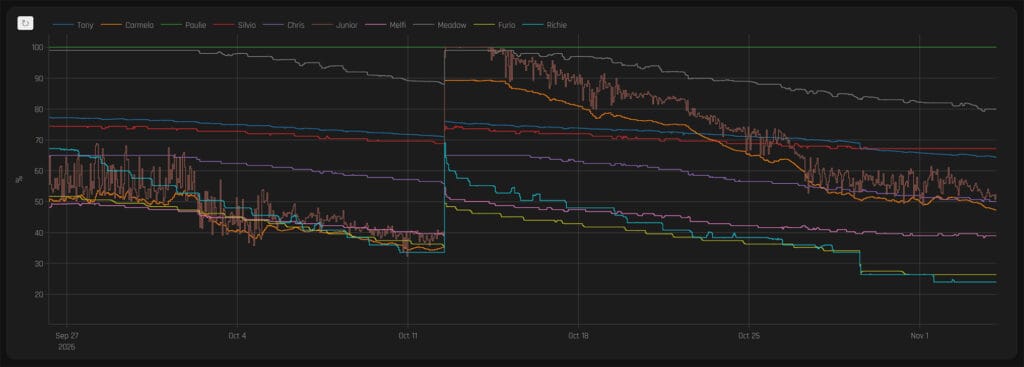
The graph above shows how all ten sensors behaved from late September until early November. I usually poured just a little bit of water to see how each sensor responded and to learn what this flower actually needs. I only watered the pot almost fully once or twice, since I was told it was not needed, but I still wanted to see how the sensors reacted.
The first thing the graph makes clear is that no two sensors truly agree on how wet the soil is. After the same weeks in the same pot, the readings spread from very dry to almost saturated, and Paulie ● sat at the top of the scale the entire time. For this reason, I stopped comparing raw numbers and focused on the shape of each line and how it reacted to watering. A good sensor should dry down slowly, jump when I water, and then keep drying down.
Ecowitt and ESPHome Sensors
Furio ● and Richie ● followed each other quite closely. They started with different readings, but they evened out and got closer together as time went on. I saw the same in my WH51 vs WH52 comparison, where the two measured moisture almost identically and stayed well within their stated accuracy of ±5%. They also read the driest of the whole group, so I decided to treat them as the reference for everything else. Their reactions to watering looked realistic to me, with Richie ● reacting stronger and draining back faster, and Furio ● reacting more gently.
Carmela ● reports a continuously changing value, since it uses Wi-Fi and is always powered on. I flashed and reflashed this device many times since my initial review, enabling the Bluetooth proxy functionality and editing the firmware in a lot of ways. I have not used it as a soil moisture sensor before, so it is practically brand new, although the firmware did take some SmartHomeScene abuse. Carmela ● is the most flexible soil sensor of the group, and you can tune and calibrate it any way you wish.
The Carmela ● line tells the same story as the Ecowitt sensors, although it reacted to watering more dramatically than any other smooth sensor. However, it reads much higher than Furio ● and Richie ● in the end. This tells me the trend is right, but the numbers need manual calibration in ESPHome before I would trust them. The calibration steps are in that same PLT-1 review.
Zigbee Sensors
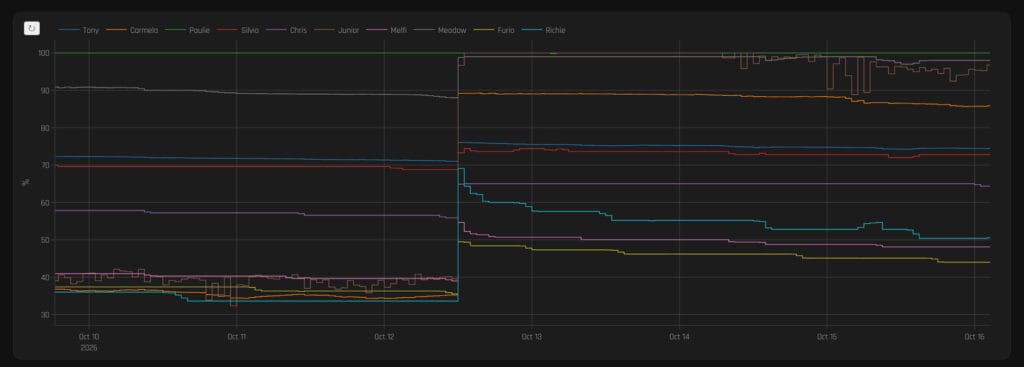
Melfi ● is the best Zigbee soil moisture sensor in this comparison. It reports on par with the Ecowitt sensors and very close to them, measures temperature and humidity and you can calibrate the sensor at firmware level. You can also configure sampling from Zigbee2MQTT directly. My only small note is that it seemed less eager to drop when the soil got dry, while Furio ● and Richie ● kept falling.
Chris ● is a close second. It follows the same trend as the Ecowitt sensors, only with a consistently higher reading. The line is smooth, steady, and practically noise free, so I would trust it for trends even if I would not trust the exact number. Do note, you cannot calibrate Chris ● at firmware level, you need to do it with a template.
Silvio ● and Tony ● followed each other very closely and always read wetter than the Ecowitt sensors. They responded well to watering, but only with small movements, and they dried down very slowly. In practice, they tell you the soil got wetter, but they can still show a comfortable number while the plant is already getting dry. Tony ● kept drifting down in the final week.
Meadow ● draws a smooth line, but it reads far too high. Even when Furio ● and Richie ● said the soil was getting dry, it kept reporting a very wet pot. It does follow the same slow decline and jumps after watering, but the scale is so compressed that I would never get a dry warning from it. Furthermore, the converter is wrongly reporting the value, with a factor of 10. I created a simple template sensor to correct this.
Paulie ● was a dud. It stayed between 98% and 100% no matter how dry or wet the soil was, and watering had no effect. The sensor was not stuck, since it kept reporting updates, but the value just floated at the top without any meaningful reading. It identified as the same ZG-303Z model as Melfi ● in Zigbee2MQTT, which clearly doesn’t guarantee the same behavior, as the hardware is different.
Junior ● respected the sampling and reporting rate I set in Zigbee2MQTT perfectly, reporting once every 600 seconds. However, its line was the most jagged on the graph, with the readings going up and down from one report to the next within the same hour. Every other sensor drew a calmer line. Its average follows Carmela ●, so it does measure something real, but I would not trust any single reading. A watering automation with a threshold would trigger on that noise.
Soil Temperature Comparison
Only two sensors in this comparison measure soil temperature, Carmela ● with its optional Dallas probe and Richie ● with its built-in sensor. And the two lines are nearly identical. They follow the same daily rise and fall, the same warm spell around October 11, and the same drop after October 18.
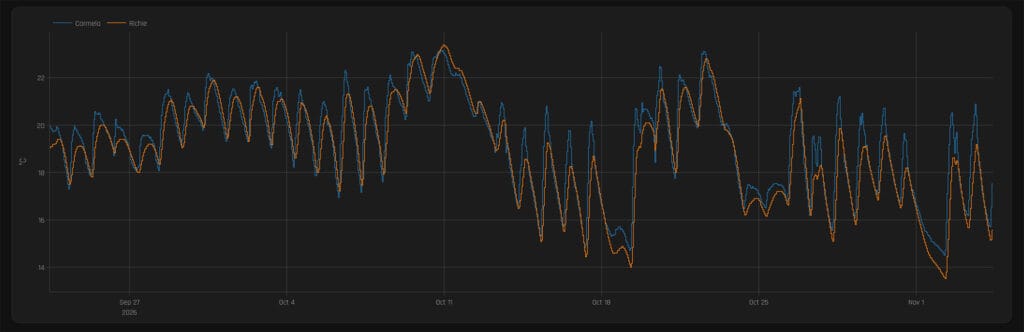
There are small differences. Carmela ● shows sharper spikes on the way up and reacts faster to every change, while Richie ● draws a smoother line overall. Richie ● also reads a little lower at the coldest points, for example in early November. The Dallas probe responds faster in the PLT-1, since it’s an always on device. In practice, either one is fine if you only want to know how warm the soil is.
Air Temperature Comparison
Eight of the ten sensors measure air temperature, so I decide to compare that too. Only Furio ● and Richie ● do not, since they are the two Ecowitt moisture probes. The graph below shows that the temperature lines of those eight sensors are nearly identical. Some sensors report a bit lower and others a bit higher, with Tony ● reading the warmest for most of the test. The dips and rises are the same on all of them, day after day.
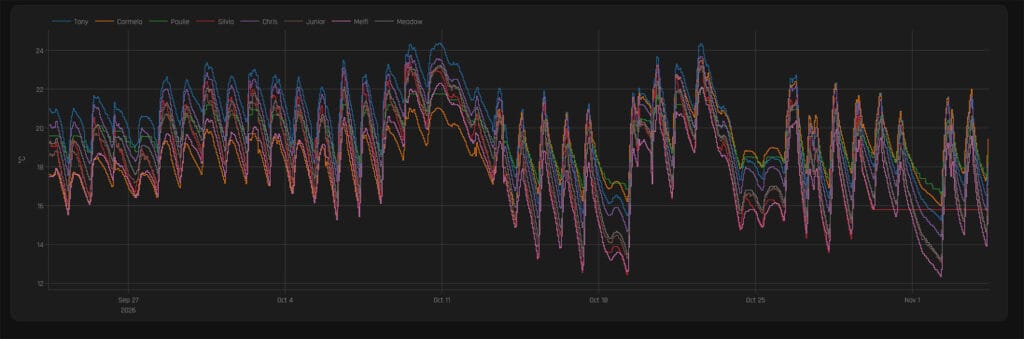
This does not surprise me, because air temperature is the simplest measurement to get right, and most devices do it reliably and accurately. If you want to learn more about this, my comparison of 12 best-selling Zigbee temperature sensors shows the same thing.
Verdict
After 45 days, my main takeaway is that no soil sensor is accurate to the decimal, and it does not really need to be. What matters more is that it follows the trend and reflects watering and drying events accurately. It should drop slowly as the soil dries and rise when I water. It should not get stuck at the top like Paulie ●, or report far too high like Meadow ●. A sensor that behaves this way is still useful when its absolute numbers are off, because you can always calibrate an offset. A sensor that ignores the soil is useless.
Verdict
4.6/ 5Ecowitt WH51
Pros
- Accurate and reliable
- Long range RF connectivity
- IP66 rated, with rubber covers
- Increased sampling during watering
Cons
- Needs gateway or RTL dongle
Verdict
4.2/ 5Tuya ZG-303Z
Pros
- Local Zigbee connectivity
- Small and compact
- Accurate, can be calibrated
- Measures air temperature and humidity
Cons
- No ingress rating
Verdict
3.9/ 5Tuya ZS-SF00
Pros
- Local Zigbee connectivity
- 5-in-1 Multisensor
- Measures soil fertility
- Adjustable sampling interval
Cons
- No ingress rating
- Noisy reporting
Where to buy
My overall pick is Furio ●, the Ecowitt WH51. It was accurate, reliable and responsive, so I used its readings as the reference for everything else. Its long range RF connection also suits gardens and greenhouses, if that’s what you are after. The only catch is that it needs a gateway or an RTL dongle. If you want to stay on Zigbee, I like Melfi ● the most. It reads very close to the Ecowitt sensors, you can calibrate it in firmware, and it works with Zigbee2MQTT out of the box.
I also picked Junior ● for fertility because I like what it tells you. Soil conductivity shows when the soil is running low on nutrients or when you have overdone the fertilizer. Together with air humidity, light, and the low water and low fertility warnings, this device covers most of what a plant needs. Its noisy line is the price you pay, so I would use it for the bigger picture and not for the single, raw readings.
Honorable mention goes to Carmela ●, the Apollo PLT-1, which is a highly versatile and flexible Wi-Fi sensor. It follows the trend well and reacts clearly to watering. It also runs ESPHome, so you can tune and calibrate it any way you wish. If you enjoy tinkering, it is the most interesting sensor of the group. For everyone else, buy for the trend and not for the decimals.
Frequently Asked Questions
Which soil sensor is the best for Home Assistant?
The Ecowitt WH51, Furio ●, was the most accurate and reliable sensor in my test, so it is my overall pick. If you want to stay on Zigbee without a gateway, Melfi ● is the best Zigbee sensor in this comparison.
Which soil sensors work with Zigbee2MQTT?
All seven Zigbee sensors paired with Zigbee2MQTT without any trouble, and they only need a Zigbee coordinator. Meadow ● is the only one that needs a fix, because it matches the wrong converter and reports soil moisture ten times too low. You need to multiply its value by 10 to correct it.
Do the Ecowitt soil sensors need a gateway?
Yes. Furio ● and Richie ● transmit by radio, so they cannot talk to Home Assistant on their own. They need an Ecowitt gateway or an RTL dongle, and I used a GW1200 gateway.
Which soil sensors measure fertility?
Richie ● reports electrical conductivity from 0 to 10000 µS/cm, and Junior ● reports soil fertility from 0 to 5000 µS/cm. No other sensor in this comparison measures it.
Which soil sensors are waterproof?
Only four sensors have an ingress rating that I could verify. Tony ● is rated IP67, while Chris ●, Furio ●, and Richie ● are rated IP66. I treat the other six as indoor only.
Further reading:
12 Best-Selling Zigbee Temperature Sensors Tested
6 Cheap AliExpress Zigbee Door Sensors Tested and Compared
10 Cheap AliExpress Zigbee Smart Buttons Tested and Compared